
Interviewed by Anne-Marie Oomen
Fleda Brown and I met in 2006 in Poppycocks restaurant on Front Street in Traverse City, Michigan. She and her husband, Jerry Beasley, had recently retired from long and illustrious careers at the University of Delaware to this small/big town, Mecca of the North, where her family history and a lakeside cottage had called them. Once settled, she wanted to find a literary community. I guess, when she asked around, my name came up, so she called and asked if we could meet. Coffee and a bite. We sat across from each other in the booth, the noise of the espresso machines running behind us. My first impression was that, for someone with credibility that runs as deep as Fleda’s, she was utterly unpretentious, down-to-earth, and easy with what she did and didn’t know. In other words, she was humble where she could have been trilly. Our conversation ranged comfortably through poetry and books, what we felt about the world of words and books in a world that was changing fast, along with good hiking trails in the region and recommendations for local eateries. At the end, prompt friends, we stood up, pulled on our coats, and promised to follow up. That was the beginning. We’ve stayed attentive to that state of being through her immense and continued success (now eleven books!), her health challenges, and her explorations of new forms in poetry and prose. She has brought rich new conversation to the literary scene—especially through her blog, My Wobbly Bicycle.
In return, I rescued a stray cat who became her and Jerry’s beloved guru/muse, Wally. When Wally died, I found Molly, the shy and damaged feline soul who spent her final years under their gentle protection. It wasn’t exactly reciprocity, but it perhaps accounts for some of the mutual understanding between us.
In all her books, but perhaps most of all in this new one, The End of the Clockwork Universe, I have watched with awe as Fleda’s mind has followed her own endless curiosity. Whenever I pick up a book by Fleda, I am aware that I should prepare for that journey. I should be ready to take a new walk with some beauty, some terrain that will leave me breathless, and many scenic views worth climbing to. Oh, and I’ll be doing this with a good friend, someone who I trust to delight me, and who knows me well. That gift. The End of the Clockwork Universe is no exception, and is a brilliant collection of new poems and prose poems laced with elements of science and deep meditations on the world.
To discuss the book, we met in Fleda and Jerry’s lovely apartment in Traverse City, Michigan, where we settled in their book-lined den. Fleda sat in a comfortable chair, dressed in slacks and a black long-sleeved sweater. She was also wearing a large plastic “turtle” back brace to keep her position stable as she healed from serious back surgery. Spring was arriving in Michigan, and the light seemed to invite this conversation.
Anne-Marie Oomen: In your new book, The End of the Clockwork Universe, the description reads that the book “explores aging, science, and the mysteries of existence through a blend of cosmic and daily life imagery, from quarks to snapping turtles, with a compassionate and curious voice…” That quote addresses only part of this book’s immense range, but of all of those mentioned, the most pervasive thread feels like it’s the science. You are not a scientist, but allusions to science are everywhere in this book, and never more than the long anchor poem “Ever Fixed Mark” about the brilliant mathematician Alexander Grothendieck. That poem centers the themes of the book. And it’s mesmerizing in its range and depth. Could we talk about that poem first? The stakes seem very high, and the thinking is richly complex without being intimidating. How did you come to that poem, and why does what he did matter to us, the readers?
Fleda Brown: I came to that poem through Benjamín Labatut’s book, When We Cease to Understand the World. He’s a Chilean writer, and I ordered his book after reading about it in The New York Times. The essays are all related to the title. This particular essay about Alexander Grothendieck was absolutely the most interesting to me. Grothendieck starts out as a famous scientist. He was teaching at the University of Montpellier and Harvard, among other places. He was well-known for solving equations that nobody else could solve. He continued to solve more and more complex mathematical problems. But gradually, he started pulling back. It was as if he had gotten hold of some knowledge that he felt was dangerous. I don’t think it was related to the Manhattan Project; I think it was just that he saw that the way we understand the world is not the way the world really is, and it was so bizarre that it frightened him. He ended up a hermit. That’s the basic trajectory. But the fascinating thing to me is what we’re seeing right now all around us, which is that we don’t understand anything anymore. In Newton’s Scheme, things seemed to make sense. People like my father could understand on a logical level. But then the world changed. It drove him crazy the rest of his life trying to understand what he could not.
Am I correct in that he was trying to understand economics?
He was an economist, but loved science. He just kept trying to figure out how Einstein was thinking because it was so different from anything that he had been able to think, and he couldn’t figure it out—which, frankly, really isn’t something you can figure out very easily. So that’s the heart of the book, which fell into place with the other things around it. It certainly wasn’t something I started out with; it just was.
So Grothendieck was a model for someone facing “the end of the clockwork universe.”
Yes. I think he understood even before he actually understood what he was getting into. And he was teaching, and he would tell his students, “Really, get out of this business, go do something else. This avenue of thinking is not a healthy place to be,” which was strange, and the students realized it was strange. So he just moved out of the world of trying to explain what was going on, and there he was, living as a hermit.
You know, because we’re literary people, you and I have sacred texts, even biblical texts in our past, and as you explain Grothendieck’s “refusal to explain,” I can’t help thinking of the creation story, the Tree of the Knowledge of Good and Evil. Knowing knowledge—and that’s an odd way to say it, knowing knowledge—is an experience that becomes both this incredible gift that we all long for, and at the same time it’s a burden and a responsibility to really know something. Like the Tree. So, through knowing deeply, do we get to the edge of what knowing is?
Exactly. My first meditation teacher said, “You have to get your sea legs,” which is exactly what I use in the book. You can’t continue to think that you’re on solid ground because you’re not. You never have been.
You’re saying this book is grappling with that edge of knowing, looking into the abyss, or looking at the breakdown of order and what that means. So is that one reason you’re using a lot of science throughout the book?
I’m fascinated by science. It’s not something I’m drawn to, but on the other hand, I am drawn to it. I keep trying to figure out what’s going on. If I can’t figure it out any other way, I ask Google to tell me a really dumbed-down version, and I’ll go through that several times. That’s the way I get hold of some of these concepts that I wouldn’t otherwise be able to.
So in your poem, “Ever Fixèd Mark,” the title then becomes ironic, doesn’t it? There is no ever fixèd mark, and that’s what these poems are going to address. That leads me to ask about voice. One of the trademarks of your voice is that your poems feel as though you are speaking directly to me. Even when, for instance, you write about dead flies, your voice is friendly, not academic per se.. It’s as if I’m in on something about the dead flies that makes them more important than they would otherwise be. I’m listening to you and asking myself, “How is she going to make this into more?” It’s as if someone is thinking right in front of me and I get to be a much-appreciated listener; I’m included, and yes, I want to be. That’s masterful tonal work. Could you talk about how you do that? How is that tonal quality making these poems more interesting to readers?
I have to say that my mother was a very simple thinker, and she would never have ever thought to exaggerate or tell a lie. My father was autistic, and it wasn’t within his range to tell a lie. And so the house I grew up in was all absolutely real at that moment. Nobody stretched a story, nobody exaggerated a story. It was just what it was. And I think both my parents were very honest, very honest—I mean, they had their problems, but they were utterly honest. I grew up not even understanding the concept of stretching the truth. So when I’m writing, I’m always looking for what exactly happened, what exactly is the truth of this situation. As far as tone, that’s my goal. My goal is always to speak directly to the audience, to the reader, to be right there with the reader. It’s innate in me.
So when you’re thinking into a poem, even a first draft, does it feel like you have a singular audience, like one person?
It probably does. It’s this imaginary person. I don’t think I’m ever speaking out into the world exactly; it feels like I want to tell you about something, and it comes out that way.
That’s how it feels when I read your poems. And sometimes you have these little hesitations in poems, like you’ll say, “I don’t know,” and I can hear you. Even if I didn’t know you, that “I don’t know” feels conversational, almost intimate.
I used to save those phrases because I know what they do for a poem. I’d read them in somebody else’s poem, and I’d think, “Yes, that’s what I want. I want that aside or interjection. I want it to feel like we’re talking about this.” When I run across somebody else doing that, I jot it down to remember what they’re doing.
But you try to be judicious with it?
Yes, because otherwise it would become mannerism.
It’s incredible, the way you create inclusivity in your poetry, even when you’re talking about high-end philosophical concepts. For example, even in discussing the Buddhist concepts that are more about consciousness, your work remains accessible.
We haven’t mentioned the influence of Buddhism on all of this. Honestly, we can talk about the myth of the ever fixèd mark, but for me, the underpinning is really Buddhist thought. Because in Grothendieck’s work, that’s where he was going. He was becoming classically enlightened, and it scared the shit out of him—which it often does. So every poem I write is an attempt to get under the undersurface. It’s an understanding of the world. I don’t want to say it’s complex exactly, but it’s very Buddhist. It’s about seeing the world in a way that is either lifted above or plows through the preconceptions that we hold about what’s true and what’s real. It’s possible to get hold of those understandings. It’s possible to get hold of the same thing Grothendieck did, which is to see the world that is deeper and richer and more expansive than he ever imagined that it would be.
And for him to see that the world didn’t follow the rules. For a man who must have been deeply committed to order, that would be shattering.
He got there through math. Other people get there through sitting on a cushion for twenty years, but he got there through math. It’s in the poem. He was figuring out formulas that nobody else had been able to figure out. Amazing brain.
Throughout The End of the Clockwork Universe, you created a series of poems about walking titled “Walk 1,” “Walk 2,” and “Walk 3.” This sequence is woven through the book. It’s as if we were spending several days together, and we were numbering walks while doing other things. And all of these walking poems have a meta quality about them. A couple cross right into Ars Poetica, but not self-consciously; there’s a quality of authenticity and the ordinary, and simultaneously, you’re speaking of poetry or storytelling or its purpose. So these poems seem to be about one thing, this walking, but are really coming sideways at art and story and poetry? What are those poems doing to the overall arc of the manuscript? And what are you really trying to do in the walking poems?
I’ve had a number of these series, of these groups that fit together. And I’ve tried putting them together, and then I’ve tried not putting them together. I prefer not putting them together because they pick up on each other later, and that gives a sense of arc—you know, you can create a bigger arc by having them scattered that way. But what am I trying to do? I start with the absolute literal level. Here is a branch; it is blooming, or it is budding, and that statement pulls me forward. What I’m really doing is following my mind. Usually, our minds go scattering off in a thousand directions. You get hold of one thing, next thing you know, you’re on another planet. You just can’t hold on. But I’m trying really hard to follow my mind as I examine what’s there as I’m walking, or the walk itself. And what does it mean? I thought about that, and I don’t know how to get at what they mean. Each one is different, each one goes in a different direction, yet they all are about experience in that moment. And if they all go in different directions, then obviously I’m sort of pulling together a lot of moments.
In that series, particularly, you often return to these ideas: narrative or poetic thought of some sort, or how metaphor works, or how we make art. Talk more about that.
I think those things are woven in because I don’t see them as separate. If I’m talking about or experiencing that particular moment, then the next level of my mind is working to make meaning out of it. And so there’s the bottom level, the walk, and then also thinking about those things at some kind of meta level. But really, it’s all the same level. It’s a way to say, “This is this, and this is this, and they’re the same.” You know my poems are harder for me to talk about, and I don’t know why that is, but they are.
Because they’re closer to that edge, the abyss?
Yes, closer to the abyss. I hope they are. Each one is close to the abyss in a different way. It’s not that the walks are a sequence. Each one is saying, “Okay, this one comes closer to the abyss in this way, and this one comes closer in this way.”
When you move from that ground level, which is literally your walk, to whatever the mind is doing while walking, you’re almost addressing the mystery in plainsong—that rhythmic connection of body to mind.
Sure, the chant-like quality. But I like that there’s not an actual chant. The poems don’t do that, the rhythm doesn’t do that, but on the other hand, the poems do that in the sense of returning over and over to the same issues in different ways, and that feels a little bit chant-like. Plus, I also think that walking—every walk follows a similar pattern, and every walk is a remaking, you know—it’s your mind-making. And every time I go out for a walk—or used to before this back surgery!—it’s a whole new thing. Even if I’m seeing the same things, they’re not the same things; they’re different, and they’re doing different things every time.
I can’t help calling attention to another strategy. Many of your poems start with a simple statement of fact about the natural world, everything from spiders to dead flies to wild turkeys, and that observation establishes a relationship. In “Robin,” you begin with one of those facts. “I check on my robin on her nest.” Or in the poem “Animals Solve Problem of Running Out of Places to Live,” the poem opens with this line: “The lined, flat-tailed gecko is working to solve the problem of the wall.” So you risk what many would call anthropomorphizing, but you always veer away from that into the larger questions of identity and Being with a capital B. In “Robin,” you eventually resolve that risk with the statement “I think I’ve misunderstood everything.” So my question is: how are animals, and these larger questions, related to each other, and why do animals become the gateway to those larger statements about existence and wonder?
They do, don’t they? The animals do that. Your pets do that, the birds outside do that. I suppose it’s because we’re straining to understand them, and we can’t fully, we cannot do it. It’s very metaphysical. There they are, just what they are, and there’s nothing we can do about it. There’s no way we can really fully understand them. So I don’t want to anthropomorphize. I don’t want to use them. I watch that robin, but it’s really not about the robin; it’s about me dealing with this issue of what to do about the robin. I guess I do make use of the animals. I make use of them, but I don’t know how else I would relate to them without making use of them. I try to make use of them in gentle ways. I think they are saying something that I can’t say for myself. That’s the part about bumping up against the limitation of language. You think about a little baby, and they’re so endlessly fascinating because you can’t understand them, and then when they get to be three or four years old, they start talking at you. It’s a whole different experience. They no longer have that same fascination; it’s become a different kind. The fascination with animals is maybe the fascination of how we function in this world that’s very different from theirs. I mean—what is an animal? So we are yearning to know how we connect to each other?
That seems important. That we communicate in some way—not only with them but with each other, because we are so different from each other. By trying to have some sense that we have communicated, particularly with the animals, that’s both impossible and affirming.
I once wrote a poem about deer in our backyard in Delaware, a bunch of deer. I just had this feeling of being honored that they wanted to be near. Like “Oh—we’re worthy. They’ve come to us because somehow we’re worthy beings.” I felt proud that they had come to us. But it’s still limited.
You and I have connected over cats, and we have this long history of loving our animals, but particularly our cats.
What is it about cats? It’s kind of beautiful and mysterious. You can just watch their tails, and you can listen to them. Ollie, our current cat, is the most talkative cat we’ve ever had. He’s meow, meow, meow! He’s always talking. You ought to hear him in the morning, waiting for Jerry to feed him. You’d think he was dying of starvation. It would be hard to be without an animal for very long because they add such liveness to everything.
Yes to that liveness. That informs the living and the working process. Let’s return to the craft. I’m wondering how all this discussion of the edge and the limits of connection might be manifested in the craft. In a recent book talk, you said a poem should be like a ski slope: you come to that leap at the end, you know, there should be a jump of some sort.
Oh, the ski slope. This is what I’ve told students many times. You’re not writing a Shakespearean sonnet that comes to a nice little click at the end, and the box is shut. You’re writing something that will take us to the edge—again—take us to the edge of what we can do with this line of thought. That’s where the mystery is, and that’s where it gets exciting. So if, toward the end, I can get it to lift off, and it leaves me a little bit breathless because I’m not sure where it might go from there, that’s really interesting to me. Poems like that all leave me a little staggered. I mean, every good poem leaves you a little staggered in some way.
I love that: “It leaves me a little staggered,” off kilter a little. And then, in addition to that leap, your poems are noted for their shifts. You make these sudden moves, graceful but unexpected; that’s where the delight comes in (and for me), the reader wonders. Can you address that—the shifts, the moves, and how you’ve learned to trust that?
That’s another outcome of trying to stay with my mind, following where it’s going. The mind is so restless and uncertain. If thought were linear or logical, you know, I might as well just write a book on science or on math. It’s when the mind loses the path and goes off in a thousand directions that it gets really interesting. I think we learn more from when it goes off-path than we do from a logical sequence. I’m a great believer in only using logic where it deserves to be used. Let the mind travel in other ways that are going to enlighten differently than the straight shot.
I see it in the prose poems particularly. You’re headed down a meandering but still connected path, and then you’ll take a 90-degree turn, off-road, off-topic. That’s when I ask myself: Where did that turn come from? You say you’re tracking the thought that you have been given, but then do you ever stop and think, “Why did my mind do that? Why did that thought make that 90-degree angle away from the original path?”
Honestly, I don’t know where it comes from. If I go off the meandering path, if I suddenly take a new direction, I’m just really pleased. I’m waiting to see where it’s going to go. I don’t think I ever ask why. What I ask is, as the poem moves along, is it holding me? Is it holding onto me? And those shifts—are you able to hang onto those shifts and do they accumulate to something that’s meaningful?
That is the real question, isn’t it? I’m often self-curious when I experience a series of thoughts that rise from whatever spiral of connections and there’s an odd one in the mix. I wonder, what was the neural connection that gave me that?
Sometimes you can trace it back, you’ve probably done that. “Oh yeah, I was thinking about such and such and of course this came up because it’s something that I remember that relates to this.” You can track it down. But I don’t think the tracking down helps very much. I think the thing to do when you get to that point is to just keep going and see what’s going to happen next.
So that gets to the writerly trust. Did you always trust that pattern, that process?
Probably not. I think I wrote some pretty lousy poems when I was young. I suspect there’s more trust in yourself when you get older. When I write now, I’m pretty trusting in what I’m going to do. Like these prose poems I’ve been working on. They come fairly easily and I trust that. I wouldn’t have trusted that ten or fifteen or twenty years ago.
But really, isn’t that the discipline, the practice of the art?
It is. And I don’t even know what I’ve done when I’m doing it. I read it later and I think, “Oh, that’s pretty interesting.” But at the time I was doing it, all I knew was that I wanted to keep going to see what happened.
But it’s never in isolation. There’s that conversation with knowledge again. At least one critic has noted that many of your poems seem to be a unique form of ekphrasis. In a traditional ekphrastic poem, the poet would be responding to a specific piece of art, but in your poems, you seem to respond to the entire tradition of art and art making. Or you explore the need of human beings to be makers. So in addition to the poems that respond to science, which maybe is another kind of ekphrasis, are you thinking about art as giving purpose to… just about everything? I’m interested in that, how art offers purpose.
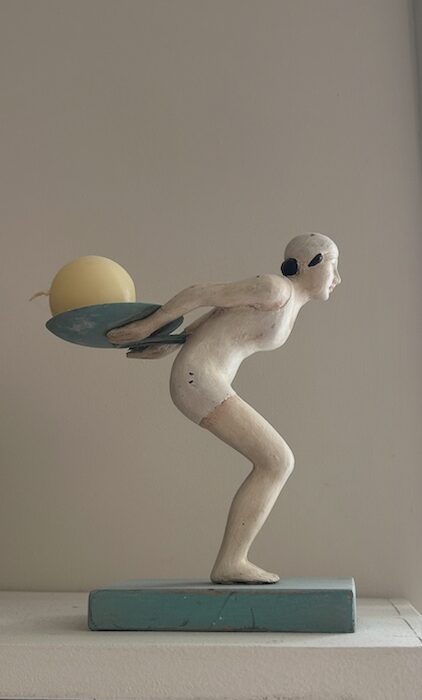
Well for example, I started noticing that little figure up there on the top of the cabinet. The figure looks about to jump off the edge of the bookcase. So I’m just traveling in my mind and I write a poem about the sense of being on the edge of the cabinet, and how it looks like it wants to just leap. It’s not really heavy, it’s a candle—but it has that candle to hold and it becomes inevitable that if you start writing about something, it’s going to end up being about art in some way. I mean, you may not say to yourself, “Oh, I’m writing about art,” but what you’re doing is exploring that thing, whatever that thing is, and the more you look at it, the more you see how it fits into the universe and how it fits into the life you’re living, and that tends to become art, doesn’t it?
Yes, so for you, “making” is a kind of artistic response to thinking. And if you stay with it long enough…
…you’re going to go somewhere. You’re going somewhere into—I guess I would say meaning. I’m very skeptical of the word “meaning” because the minute you say something means something, you’ve made up a little story about it. So you have a story about it, and you can call that meaning if you want, but it’s your story about it. It has absolutely no intrinsic meaning. This again is my Buddhist background.
So, forgive me, I want to go back to that idea of Thought, with a capital T. You seem acutely aware in these poems of how thought actually works, particularly as it shapes what we might call imagination. I noticed this particularly at the end of “Walk 5,” where you write about how you are imagining the life jackets hanging on the bump-outs of the bridge. I can see that perfectly, in part because I happen to know that bridge, but in that poem, you speak of the illusion in the mind that is seeing the life jackets because we, the readers, are really not there. Could you talk a little bit about how the idea of thought imagines in order to bring some new idea to the surface?
What I’m really saying is, “That’s what you thought, but that wasn’t it.” I’ve just told you about this bridge, and so you think you saw it, but you didn’t, because I wasn’t there—it’s a way to talk about perception not being the truth.
In some of the lines in that poem, you talk about being two or three times removed from the experience; you’re imagining this scene, then giving it to us, but because we have never been there, we are imagining the scene differently. So there are several removes in that poem. That’s fascinating because that feels like what thought is, an exploration of these removes.
I almost think that poem is kind of like a teaching poem. I worry that I’m always teaching. I try to back off from that, but you know, that’s a poem where I just feel like I want to proclaim, again, that nothing is what we think. I’m thinking about this experience, and you think I’m there and I’m not. The whole world is a fiction, glorious and fine, but it is fiction. And the whole world of thinking is fiction, because fiction isn’t the thing, thinking isn’t the thing. Thinking is thinking.
So our “fictioning” is how we narrate the thinking? And then the poem becomes a commentary on that?
Sometimes it sounds like it’s a bad thing, but this is the way we live; we have to take objects and make meaning out of them. I mean, we can’t live otherwise.
Maybe that process makes us more connected to each other. Your little candle sculpture up there on the edge of your cabinet is connecting you to your friend.
Exactly.
Final questions. In this time of really big, nervous tension that is global and feels soul-splintering, what do you hope your readers are going to take away from Clockwork Universe?
It’s one example among various ways to talk about the expansiveness of the universe and the expansiveness of being human, to get to that idea that there is more here if we look. I’d like to think that if we could really see one thing, we could watch it as an example of the richness and surprise of the whole universe. For example, in the opening poem “Wild Sweet Peas,” I didn’t expect those sweet peas to be there beside the road in all that brush, but they’re there. It’s a matter of giving attention to a tiny detail that is really everything.
In that image of the petals at the end, you compare them to “small pink wings.” You make the petals into wings, and that suggests all those associations with flight. And that metaphor inspires that thought cycle in the reader. We’re in a kind of thought flight. That’s a beautiful answer and could probably serve as the end of the interview, but is there anything that you want to talk about?
Well, we haven’t talked about humor, but—
Oh, yes, let’s talk about that.
I don’t think I’m a funny writer, but I sometimes think that I’m maybe witty or wry.
I was just going to use that word. There’s a wryness in a lot of your work.
I don’t know what to say about that except that it’s a natural tendency for me to think that way. Once, I was on Zoom, and someone said something like—this kind of hurt my feelings, but he didn’t know it—I’m not feeling very much warmth. What I’m feeling is logic. And I thought, “Wait a minute.” Backing off, being wry or witty can be a really deep connection. It doesn’t have to be cold. Think of the line of that old poem: How do I love thee, let me count the ways—that is a certain kind of love poem. But it’s hard to write like Elizabeth Browning these days. Maybe we have lost a certain innocence. A wry quality is an almost natural response.
I see that. It’s not sarcasm, but a quiet irony?
Irony is exactly the right word because irony is seeing that the world isn’t what we thought it was, isn’t it?
There are other examples of that quiet wryness, as in “Clothesline” where you write, “I am very aware of the limitations. Once I could fly anywhere / as if the wind and I had a deal.” There’s a setup in that you are now aware of the limitations, but there’s a little whimsy in that interaction with an inanimate object, the wind. It’s quietly powerful. And wry.
Thank you.
Thank you for this opportunity to talk with you, to be in this deeper conversation. I’m grateful that you are so fearless about approaching the abstract and the way craft and Thought interact to make a poem. Clockwork Universe is a brilliant book. It really is. I have been going back to certain passages and pages and these poems move me in ways that I have been hungry for and that I find hopeful. I think it’s going to do really well.
You never know.
Fleda Brown’s eleventh full-length collection, The End of the Clockwork Universe was published this fall from Carnegie-Mellon University Press. Doctor of the World won the Finishing Line Press Chapbook Contest for 2024. The Woods Are On Fire: New & Selected Poems is available from University of Nebraska Press. Her work has appeared three times in The Best American Poetry and has won a Pushcart Prize, the Felix Pollak Prize, the Philip Levine Prize, and the Great Lakes Colleges New Writers Award, and has twice been a finalist for the National Poetry Series. Her recent memoir is Mortality, with Friends (Wayne State University Press, an MIPA Winner and Midwest Book Award winner in memoir). She was poet laureate of Delaware from 2001-07.
Anne-Marie Oomen was awarded the Michigan Author Award (2024) for Lifetime Achievement. Her memoir AS LONG AS I KNOW YOU: THE MOM BOOK won AWP’s Sue William Silverman Nonfiction Award (University of Georgia Press), a Michigan Notable Book Award, and a Silver IPPY. She edited ELEMENTAL: A Collection of Michigan Nonfiction, and co-authored The Lake Michigan Mermaid and The Lake Huron Mermaid, (with Linda Nemec Foster). Earlier books include Pulling Down the Barn, House of Fields (Michigan Notables), American Map: Essays, Uncoded Woman (poetry), and Love, Sex and 4-H (Next Generation Indie Award for Memoir). The Long Fields: Essays of Comfort and Home (Cornerstone Press) is her most recent collection of new and selected essays. She teaches poetry and life writing at Interlochen College of Creative Arts and libraries throughout the country. Visit her at www.anne-marieoomen.com