

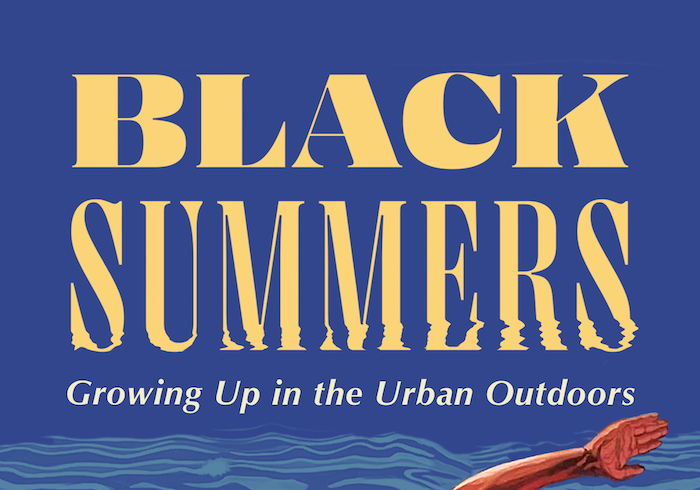
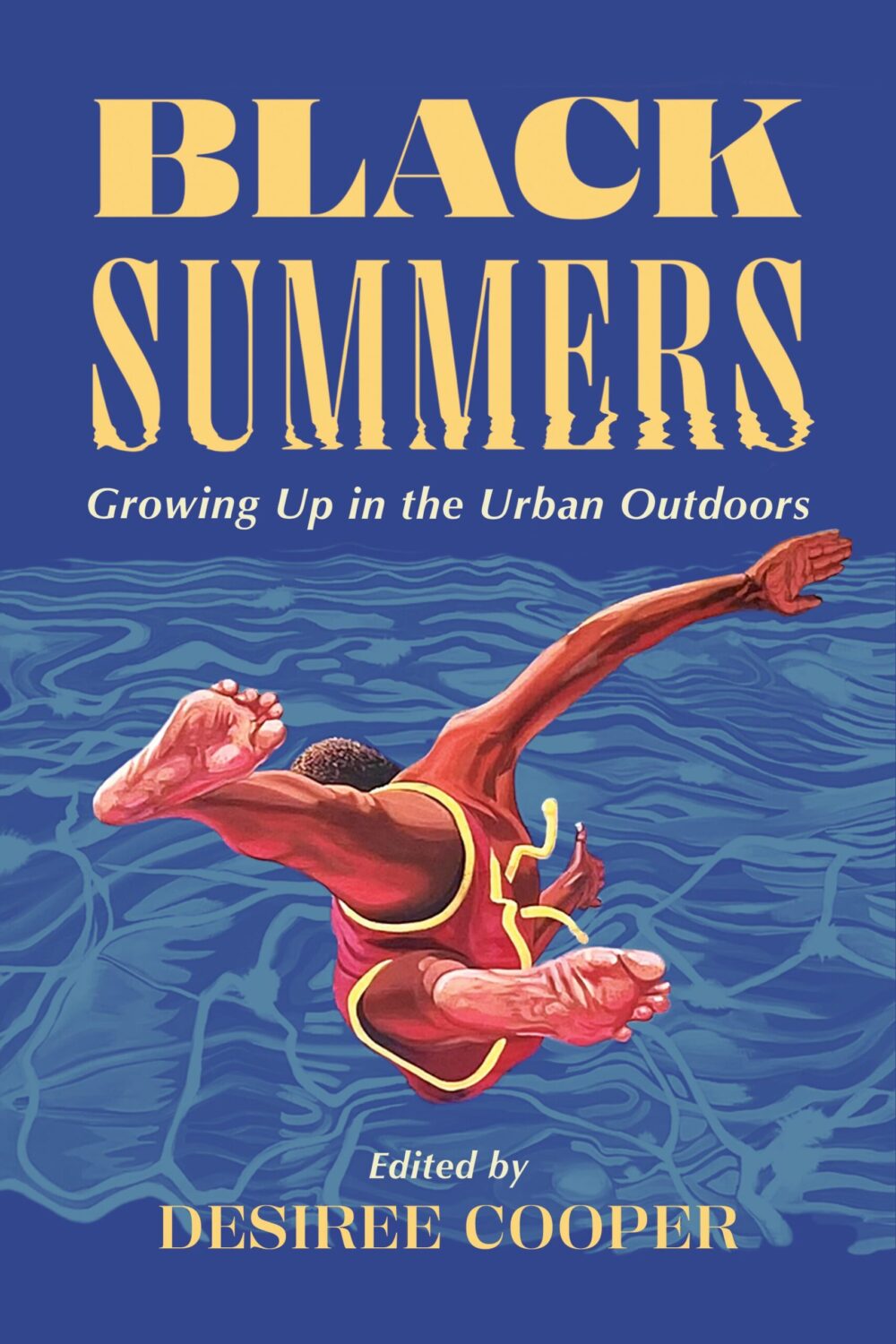
Tina Jenkins Bell interviews Desiree Cooper about Black Summers: Growing Up in the Urban Outdoors
The essays, poetry, and comics in Black Summers are written by Black Detroiters who describe how race shaped their experience of outdoor spaces. After white flight in the 1960s, Detroit’s plummeting tax base caused city resources to crumble and disappear. Parks, recreation, and public spaces receded. Homes and bustling neighborhoods became clipped flowers, browning around the edges and rotting from the outside-in. Crime, redlining, structural racism, and policing, more protective of things than people and community, compounded Detroit’s urban decay. These stories demonstrate the struggle and resilience of a people who refused to be minimized and erased and who, through exploration, innovation, and determination, raised themselves from the ashes of a city, once abandoned and discarded.
I knew the stories of Black Summers viscerally. I was born and raised in Gary, Indiana, a sister city of the Great Migration, where millions of African Americans left the Jim Crow South for work in the industrial North. Richard Hatcher served as the city’s first Black mayor from 1968-1988. I watched a proud city where jobs were plentiful, and crime was low, become “the murder capital of the world.” A great city was bled dry by redlining, white flight, industry loss, and abandonment by state politicos who didn’t like the shade of the city’s leadership. Other cities like St. Louis, Newark, and Baltimore experienced a similar trajectory. Understanding this historical backdrop, it’s no wonder these stories out of Detroit, full of both joy and pain, were so relatable and recognizable. Together, they paint a picture of a people who insist on “making a way out of no way” and whose dexterity in navigating structural racism, bigotry, and other minimizations are worthy of everyone’s awe. Knowing this, I looked forward to diving deeper into the inspiration for and premise of Black Summers in this interview with Desiree Cooper.
Tina Jenkins Bell: Black Summers is dedicated to Lizz Haskell (formerly known as Sarah Elizabeth Ray). Who was she?
Desiree Cooper: Sarah E. Ray was one of the many unsung Civil Rights heroes whose courage paved the way to the Civil Rights Act. We often focus on the fight for equal access to schools, businesses, jobs, and housing. But establishing equal access to leisure and simple fun was also part of our march toward freedom. Ray’s fight to integrate a Detroit ferryboat during World War II established an iconic summer experience that defined Detroit for nearly a century.
In 1945, Sarah Ray, who had migrated to Detroit from Tennessee, boarded the steamer nicknamed “the Boblo Boat.” The boat sailed summer revelers from a dock in Detroit to an amusement park on Boblo Island in Canada. Ray was there with her white classmates celebrating their secretarial school graduation. The others watched silently as she was kicked off the boat, which excluded Negroes and “zoot suiters.” Ray took her refund, threw it at the boat, then marched to the Detroit NAACP to file a complaint. Unbelievably, the case reached the U. S. Supreme Court where, in 1948, her right to ride the ship was affirmed. Thurgood Marshall was one of the lawyers who filed a brief in the case.
In the years that followed, sailing on the Boblo Boat became a defining experience during Detroit summers. It was known for the pure fun, the mixing of people of all backgrounds, and the sheer bliss (and cachet) of boating on the Detroit River. But Ray’s fight to integrate it was totally forgotten. And, as she continued her community activism over the years, she rarely talked about it.
I found out about her story when working as a columnist at the Detroit Free Press. Years later, I met filmmaker Aaron Schillinger who was doing a documentary about the Boblo Boats (“Boblo Boats: A Detroit Ferry Tale”). Her forgotten story became our obsession. In 2018 we started The Sarah E. Ray Project dedicated to raising awareness of her contribution to our freedom to have fun. We’ve done many lectures in libraries and schools, written teaching guides, and advocated for her to be included in the New York Times’ 2023 publication, Overlooked: A Celebration of Remarkable, Underappreciated People Who Broke the Rules and Changed the World.
How was she the spark for this collection?
A few years ago, I wondered what she’d think if she were alive today. Would she be in awe at the access that African Americans now have to the urban outdoors? Or would she be disappointed to find that racism is still very much alive when it comes to summer fun? I decided to ask Black Detroiters of various ages and backgrounds to consider how race continues to shape their experiences of outdoor life.
Are you saying that despite integration, racism has created an infinite loop where Black Detroiters make gains, lose those gains, and in some cases digress? Which of the essays, poems or comics in the book emphasize that infinite loop?
Exactly. Racism in America follows a basic law of physics: For every action, there is an equal and opposite reaction, or backlash. This is the theme of many of the essays. I love the example described by MARS. Marshall in his essay, “Where the Run At?” As a child in Detroit, he was a fan of the Pistons, a championship basketball team that only played “home” games in the far suburbs. The games were inaccessible to the average Detroiter. African Americans often viewed this as an affront to the city. When the Pistons returned to Detroit in 2017, it ended a 40-year redline of Detroit. As Rochelle Wilson-Ellis writes in “A Boatswain’s Boblo Memories,” “It’s hard to witness stuff constantly shutting down without thinking, ‘They don’t want us to have anything.’”
Years after the incident on the Boblo Boat, Sarah Elizabeth Ray adopted her married name of Lizz Haskell and became a community empowerment activist. But she never set foot on the Boblo Boat. In some ways, that reminded me of Faith Reingold’s plight. Reingold was a Black artist, quilter, and activist who fought for equity and inclusion for Black artists, particularly in the Smithsonian American Art Museum. Reingold won the fight, like Haskell, but while her efforts opened the doors for other Black artists, her work was excluded. Does Black Summers address this bittersweet irony?
Why didn’t Ray revel in her victory, and sail proudly on the Boblo Boat every summer? It’s a question that I haven’t been able to answer through my research.
However, several of the essays shed some light on why she may have intentionally melted into obscurity. One word: trauma. We tend to view social activists as brave people who purposely make good trouble. But often, they are ordinary people trying to do ordinary things and smash headlong into the brick wall of racism. No matter how acclimated one is to the irrationality of racism, it still can come as a shock when you suddenly face it. Several of the writers convey what that moment feels like: the confusion, the anger, and the pain of being treated differently because of the color of your skin. I imagine that Sarah Ray was equally humiliated and enraged. The last thing she ever wanted was to be a part of that enterprise ever again.
In what ways does Black Summers document the racial legacy of urban abandonment?
That’s the unifying history of the collection. What happened in Gary and Detroit, also happened in Cleveland, Chicago, Pittsburgh and other Northern industrial cities where white flight accelerated as Black empowerment grew. By focusing narrowly on Detroit, my hope was that Black Summers would inspire similar conversations in the sister cities of the Great Migration.
The stories also intimately describe how even the most innocent, “carefree” moments of summer fun are shadowed by fear, trauma, marginalization, and socio-political neglect. One great example is the story of Detroit’s beloved Belle Isle, a nearly 1,000-acre island park in the Detroit River. As described in the essay, “Detroit Boricua,” it has long been a place of sanctuary for city dwellers. But as the city’s coffers shrank due to white flight in the 1960s-70s, the park fell into disrepair. Finally, in 2014, the state of Michigan leased the park and took over the management of the island. That was largely viewed as Black disenfranchisement. It didn’t help that the park was suddenly over-policed by state officers.
“After those encounters, I thought about not going to Belle Isle as often,” wrote Angela Atabex Lugo-Thomas in her essay. “But I felt strongly that if I stopped going, I would be letting them win. It’s the people’s park; they were the visitors, not those of us who grew up going there.”
This tug-of-war continues today as gentrification and redevelopment renews once-abandoned buildings and institutions, but also redefines who gets to be there.
Despite this problematic history, the collection reflects a spirit of joy, innovation, and community. Did this come as a surprise to you?
Not much about Detroit surprises me! When I moved there in the mid-1980s, I was struck by how much pride residents had in the city despite its obvious challenges. I learned that there are different measures of “sanctuary.” For some Detroiters, white flight was the trade-off for sovereignty over their city—and they were OK with it. Writer Pamela Hilliard-Owens said in her essay “The Black Middle Class”: “As our neighborhood got Blacker, pride got stronger, and the village, tighter. My parents hadn’t come to Detroit to befriend white people; they’d come for equality of opportunity.”
That Detroit grit even impacts the idea of fun. When neighborhoods lacked recreation centers in the 1970s, Detroit Mayor Coleman Young brought shipping containers to the neighborhood, which were filled with water from the fire hydrant. The creative innovation called the “Swimmobile” is a beloved memory of summer.
The “Slow Roll” is another Detroit innovation. Rather than biking for exercise or sport, the city has a regular cavalcade of cyclists of all stripes, slowly migrating down city streets. The group often swells into the thousands on tricked out bikes, beach bikes, bikes with child carriers or speakers, bikes blinking with LED lights. The only point is to hang out on late summer nights. It’s wild and slightly post-apocalyptic if you come across the parade on a late summer night.
The insistence upon Black joy exhibited by Detroiters is the silver lining ringing the dark, ubiquitous cloud of racism.
Some of the essays, like “We On the Lodge With It” emphasize the intentional compacting of public space, edging Blacks out of public participation, decreasing their presence, and creating invisible though palpable walls—think Gloria Naylor’s The Women of Brewster Place—restricting Black movement. Do you agree?
Absolutely. That makes me think about the current “teen takeovers” nationally, where young people mob public spaces. When groups are marginalized and/or policed out of mainstream interaction, they either create their own enclaves or they appropriate a space. This theme plays out in Nandi Comer’s “We On the Lodge With It,” where cruising in the Motor City has become increasingly policed and marginalized—so the drivers in her essay take over a freeway. Car counterculture is nothing new, but it’s worth mentioning that in Detroit there is a police-sanctioned “Dream Cruise” every summer in the near suburbs that disrupts traffic and negatively impacts businesses but is nevertheless celebrated as “quintessentially Detroit.”
The tension also shows up in Tommye Blount’s “Desire Paths,” about a park that was a haven for gay men, and Jean Alicia Elster’s “Neighborhood Constitutional” where a reclaimed railway changes the tenor of a neighborhood.
Not all of the essays address public space though they do address how racism shapes summer experiences. Can you elaborate?
Some of the essays explore why the contributor DID NOT spend much time outdoors. One teen writer, Mic Jennings, imagines the summer streets being haunted by a “Summertime Krampus,” making outdoors unsafe. Others equate summers with meandering drives or early morning walks on city streets—but not directly engaging with the natural world. For all of these, there are racial underpinnings as to why a car ride, for example, is the only way to safely enjoy the outdoors.
In “Flight of the Bumblebee,” Satori Shakoor finds refuge indoors, practicing her violin so that one day she will be able to attend an elite, summer music camp. But even in the safety of her own home, the abuses of class, race, and gender invade.
Black Summers also addresses the division in race by class in “Borderline.” Can you discuss how this essay addresses public space, Blackness, and class?
Race is a factor in how urban dwellers experience the outdoors, but class is also a factor. Renee Simms, who grew up in an all-Black, secluded, suburban enclave, explores the intra-racial class divide in “Borderline.” Thanks to Eminem, 8 Mile is well known as one of the defining borders between Detroit and the suburbs. Simms notes that plenty of Black families migrated across 8 Mile seeking refuge from the violence and blight of Detroit, especially following the 1967 Rebellion. Sometimes this is regarded as “Black flight.” But for me, this is a misnomer, as the Black residents were not necessarily fleeing Blackness, but poverty. Still, it’s clear that Black classism has also been a factor in the abandonment of Detroit.
Can you discuss how two poems, “Feral Fields” and “The Trump Boot” discuss the ecology of Blackness?
As Black urban dwellers, we are caught between two myths. The first is the belief that nature doesn’t exist in cities. The second is that African Americans don’t appreciate the outdoors.
“Feral Fields” by Esperanza Cintrón enumerates how much random nature thrives in urban spaces. In Detroit, there has been so much abandonment that people have co-opted or even purchased empty lots and farmed them. There are fields where wildflowers thrive as well as plots with carefully cultivated gardens. There is a very strong farm-to-table culture that was alive in Detroit before it became trendy.
Nandi Comer’s poem, “The Trump Boot,” addresses why many African Americans are uneasy with the outdoors. In the poem, Black hikers visit the Michigan “thumb” (imagine a mitten) for the fresh air, the stunning views, and the big sky. But ahead of them on the trail, someone has decided to use their boot to write “Trump” in the dirt. This is not only a political act, but a threatening, racist one. Why would someone do that while hiking in the woods if not to send a discrete message to the Black hikers behind them? The poem points out a generational concern for people of color: No one wants to get caught alone in the woods where they are vulnerable to hate crimes.
Your contribution to the collection is a short, lyrical piece called “We Water.” Was it inspired by “We Real Cool” by Gwendolyn Brooks?
There is no direct connection, although I like to think that Brooks’s work is part of my literary DNA.
“We Water” confronts the stereotype that Blacks don’t like to swim and are afraid of water. Given opportunity and access, we appreciate water as much as anyone. But I do think that, for African Americans, water is also imbued with ancestral memory, the horror of the Middle Passage, and spirituality. By using “water” as a verb, I attempt to describe our true relationship with water. It’s an action, a flow, a feeling. In one paragraph in “We Water,” I reflect on how water shows up in gospel and R&B music. The piece starts with a list of rivers that were the last obstacle to freedom for those escaping slavery. And finally, there’s a nod to the joy that water represents, including Detroit’s huge boating culture, which comes as a surprise to many.
BUY BLACK SUMMERS FROM WAYNE STATE UNIVERSITY PRESS OR YOUR LOCAL BOOKSELLER.
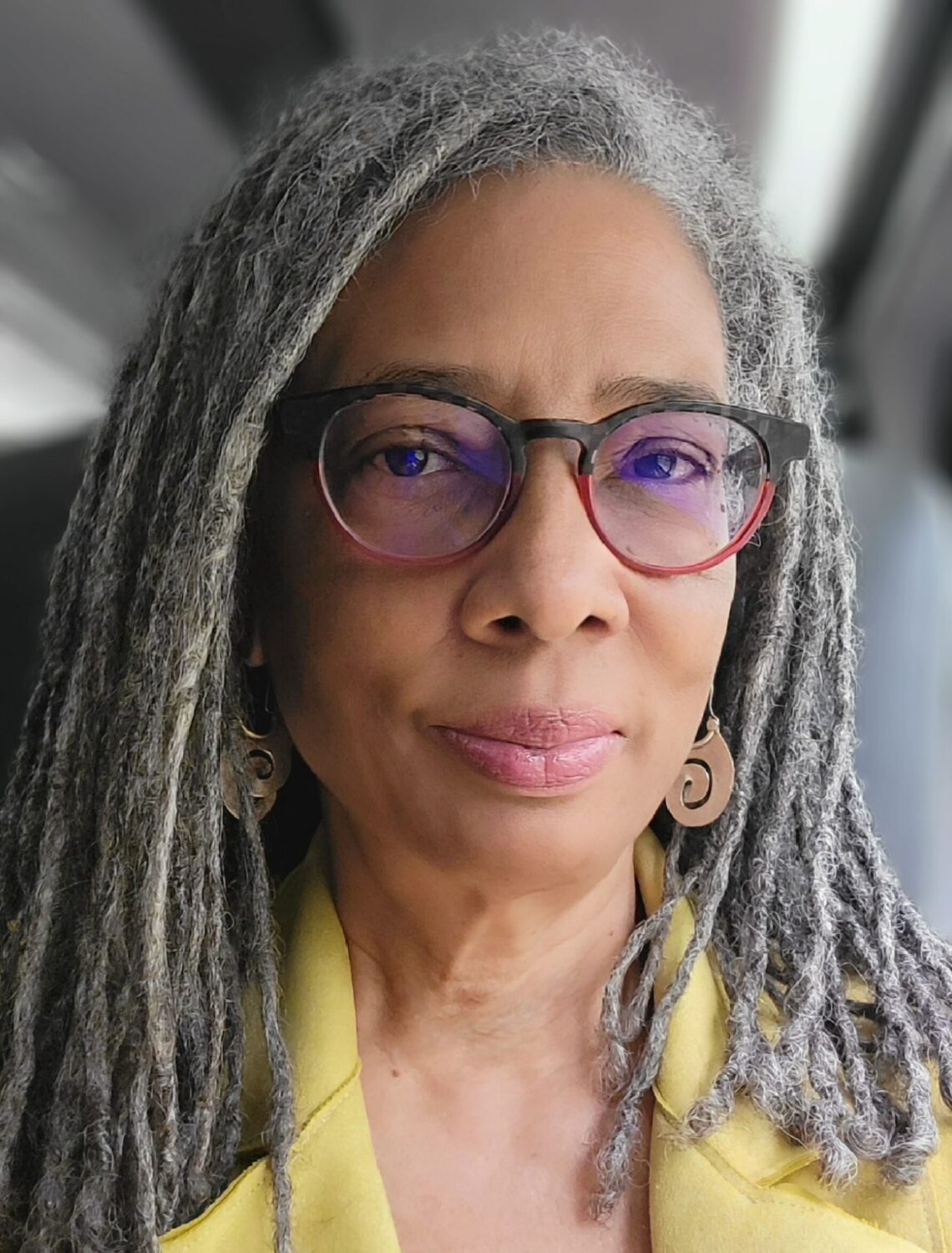
Desiree Cooper is a 2015 Kresge Artist Fellow, Pulitzer Prize-nominated journalist, and former attorney. Her work has appeared in The New York Times, Oprah Daily, MSNBC Daily, Flash Fiction America 2023, Michigan Quarterly Review, Hypertext, and noted in The Best American Essays 2019. Cooper is the author of the award-winning flash fiction collection, Know the Mother. Her children’s picture book, Nothing Special, is a 2023 Paterson Prizewinner and one of the New York Public Library’s “10 Best Children’s Books of 2022.”
Tina Jenkins Bell is a published fiction writer, playwright, ekphrastic prose writer, and literary activist. She has had numerous short works published in journals and anthologies, most recently including “Kaiko,” The Overturning anthology (2025), and “The Avalon Haint,” Redline: Chicago Horror Stories. Three her plays were produced as dramatic readings, including Death of a Marriage, now commissioned as a part of Definition Theater’s Amplify New Plays Program.
A supporter of the literary community, Bell is a co-founder of FLOW (For Love of Writing), the founder of the Write Jam Critique Circle, and a member of Our Chapter. She has collaborated with numerous writing and arts organizations, authors, and bookstores to offer literary programming in Chicago’s underserved communities. Bell is currently working a short story collection, I Am Her. In 2026, the Guild Complex named Bell one of 35 Writers to Watch.