

Interviewed by S.L. Wisenberg
I met Janet Burroway in 2008 and as I’ve grown older and she’s grown older, she’s become a role model for me. At eighty-nine, she’s just published her ninth novel, Simone in Pieces (University of Wisconsin Press), which the New York Times characterized as “a series of slyly eloquent chapters.” The titular Simone grows from a Belgian orphan rescued and resettled in England during World War II to a retired American professor in her 60s. The chapters are interspersed with chapters from the point of view of people who encounter Simone, briefly or more deeply. The alternate POVs are not add-ons. These cameos are from living, breathing individuals often in turmoil, and whose sections broaden the context, lending a kind of Dos Passos feeling to the book.
This is Burroway’s first novel not from a major press, and she has opinions about publishing. We’ve been in the same writing group for a number of years, and I’ve grown familiar with Simone, chapter by chapter. She is adept in English but a perpetual outsider whose incomplete childhood memories keep her from being grounded. As I read the novel between covers I found it fresh and vivid and new. There’s the cringe moment when she finds out she’s been lied to—she hasn’t been chosen for a college play after all; there’s her misapprehension that the show she’s going to see is “Nickels in May”—she finds out it’s a performance by the duo Mike Nichols and Elaine May. There’s the man she shouldn’t marry but does, and the sympatico colleague, Leo, married to a fellow Hungarian refugee mentally damaged by her treatment in the 1956 revolution. For decency’s sake, Simone and Leo refrain from a romance while he’s married.
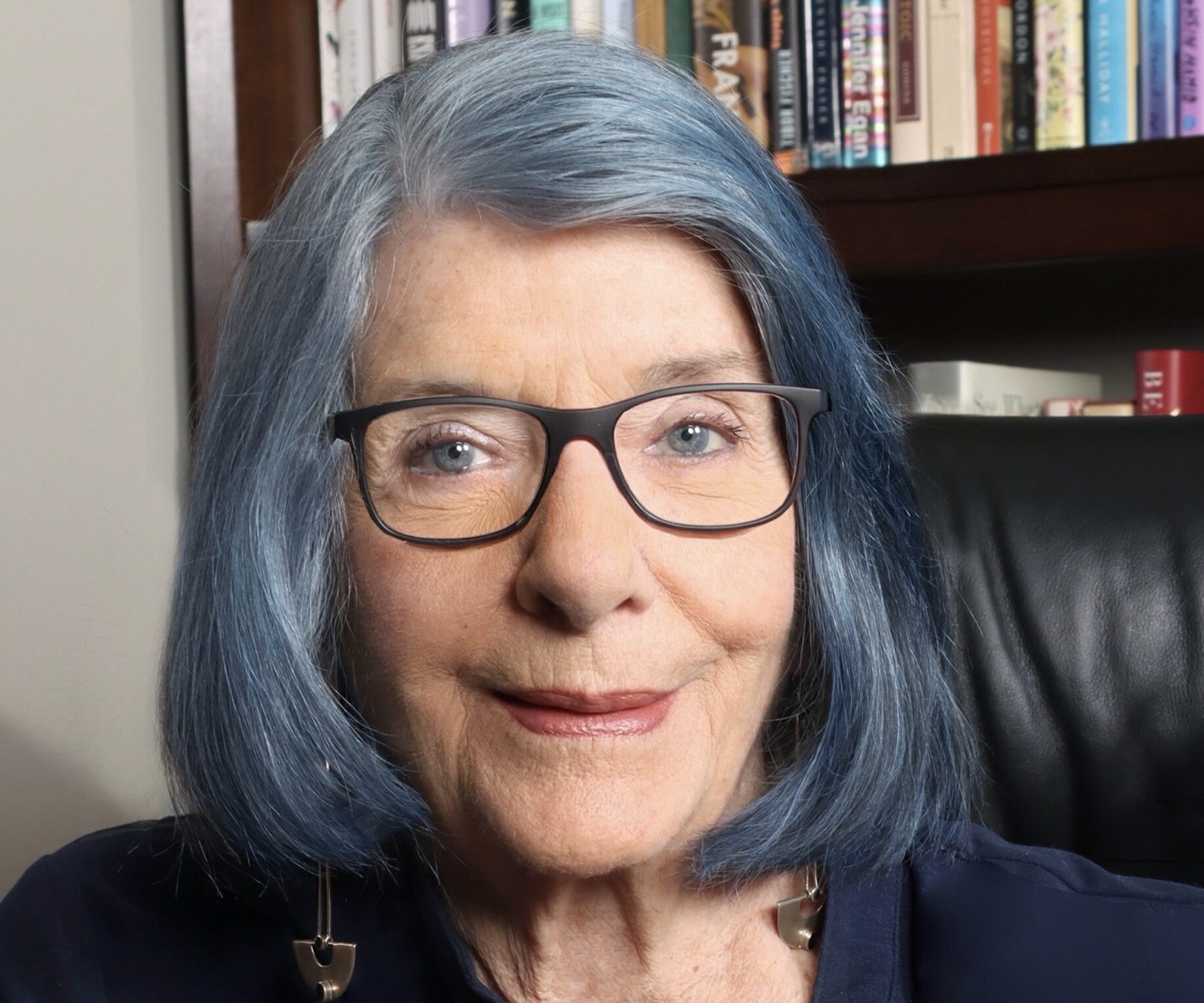
Maker of rebuses and pies, Burroway is regal in her walker, a wearer of stunning turquoise jewelry, creator of the most widely used fiction-writing text in the United States. Her hair is light blue, first dyed when her granddaughter dyed hers. She has written plays, nonfiction, poetry, song lyrics, children’s books—20 books in all. Her nonfiction includes essays (“I Didn’t Know Sylvia Plath,” though they were acquaintances in England) a memoir of her son Tim, a soldier who committed suicide.
Burroway is the Robert O. Lawton Distinguished Professor Emerita at the Florida State University. She now lives in a landmark building across from the Art Institute of Chicago with her husband Peter Ruppert, Utopian scholar and film critic, and a cat named Nutmeg. We talked on Zoom about her latest novel and had a couple of follow-up email exchanges. This interview has been edited for length and clarity.
S.L. Wisenberg: Can you tell me about the seed of the book?
Janet Burroway: In the late 90s, I wrote a short story. And it was intended to be a funny satire of a department meeting. I invented all these characters who have names that are kinds of criticism. So there was a dean named Riddick, and his nickname was Nuke, so he was New Critic.
This second one got into the novel: There’s Harriet Roe Glaucia who is called Hetty, so it’s Hetty Roe Glaucia. Heteroglossia. I was having a great time doing it. It was told from the point of view of this little old lady who was very sharp and very suspicious of her department personnel. And then that short story just took a hard turn into grief that she had.
And I had not intended that. I love it when my characters say something that I didn’t expect them to say. It’s usually some kind of intuition, but this was extreme, and I realized that I could not really finish this short story unless I knew this woman’s story. So I stayed up one night and figured out her story from birth to this old lady, and I woke up Peter, and told him what I had done, and what her life was, and he said, “That’s your next novel.”
It wasn’t. There was another novel, and a memoir, and a family tragedy, and three updatings of books. When I went to start it with the intention of writing a novel, I wrote from Simone’s point of view about her being on the boat that brought her from Belgium to England.
And I wrote it, and wrote it, and wrote it, and it did not work, and it wasn’t working, and it didn’t make sense, and then I realized that she can’t tell that story because she doesn’t remember it. I have to tell it from the point of view of the woman who is holding her in a blanket on that ship. That was the first time that a different point of view came to me. And then, again and again, I kept hearing other people, some of whom were very fond of her, some of whom were profoundly affected by her, some with whom it was just a glancing encounter.
For a long time, my idea was that the main thing was her traveling from here to there. There were a lot of these little transits, I called them, between the chapters. On a boat, or a train, or a plane, or a car, or some different form of transportation, even a bad trip.
That department-meeting story is not part of the novel. I tried to fit it into the novel but it didn’t fit.
How did Simone change in your mind as you wrote?
I think that it was not so much a change as a realization: As she was encountering all these people, I didn’t really know who she was. And I was conscious of the fact that she, at one point, says, “I have no more.” She had no more self than a fruit pit spat out over the Carolinas. She does not know who she is, because she doesn’t remember her childhood. And if you lose your memory, you don’t know who you are.
And you’re saying that the changing of points of view was something that just happened?
Yes, yes, the different voices kept coming into my mind. But, you know, I kind of feel as if that sort of thing happens to a writer for a reason.
And that the reason here was that she was in pieces, that she was all to pieces, but she also had to make herself out of the pieces of these encounters. These encounters, some of them deliberate, but a lot of them just accidental, coincidental. It’s in encountering other people that we learn who we are.
Some of the stories that are from other people’s point of view are really mostly about them, the speaker.
And in those cases, I think they more indicate where Simone has arrived in her life than they do how she is affected by the encounter.
How much research did you do? I noticed all the details of the setting, in England, especially. And I know that you spent time there when you were a young woman.
And really into old age. The research into England—there was virtually none and I kind of fear when it’s published in England that people will say, “That’s not how a grammar school would have been.” So I had my son, who has lived in London since he was 17, check all that stuff.
Some of it he didn’t know, so I hope I got it right. But I lived in England for 12 years altogether.
I went there first on a two-year Marshall scholarship at Cambridge, Newnham College, took a degree there. It’s a second BA in English literature, but after five years, if you pay a fee, it becomes an MA.
Simone lives in a lot of places that I’ve lived, so I didn’t do much research in those places. The kind of research I did was on teaching goldfish how to swim a maze [which is the work of a scientist who is a colleague–and more–of Simone].
And for the subject of memory loss (in another character), I read several books, of which I acknowledge one in the acknowledgements that was helpful to me. And an old friend who had been to Vietnam told me about his experience, and then edited the chapter on Kai Maginnis, who was in Vietnam. There were things I had in the wrong location. And I had the wrong kind of tree that he and another soldier climbed into. It was a banyan.
Was it fun to work on the book?
Absolutely. I love doing all the voices and getting myself inside those other characters. It’s certainly the most people that I’ve tried to capture in a novel. Other people helped me put Simone together. There was, for example, a friend who had been in Poland during the war, and described to me how hungry and lonely she was because her mother went out at night to find food. I had a silly source: At Writers at Work in Park City, Utah, I was on a panel with Richard Ford and we were describing our process, and he said, “Well, what I do is write little ideas on scraps of paper as they come to me, and stick them under my bed.”
Under the bed? Not the pillow?
No, under the bed. And in the morning, he reaches down and pulls out a scrap of paper and sees if it speaks to him. And he said, “This morning, for example, I picked out a piece of paper that said , ‘My mother used to have–.’” And so, I put those two things together, the story of this girl in Poland, and “’My mother used to have—.’” I found a lot of things that a mother could have had in the past. It’s kind of a refrain that comes through that chapter when Simone does finally remember her childhood in Belgium.
You traveled to Belgium?
Yeah, I went to Liège. I had only ever once been to Liège, and it’s Walloon, and I had picked that because I speak French and don’t speak Flemish. I stayed there for four days and just wandered around and thought about her, and what her childhood was. I picked the place where she lived with her parents, which would be identifiable to somebody who lived in Liège. It’s an apartment building on the river that has these golden blue panes, mosaic panes, on the windows. I picked her school. In an antique shop I saw a portfolio of old pictures of the town in the ‘40s. It was $250 and heavy, so I didn’t buy it, but I did get ideas for what it had looked like in the war.
Did she surprise you as you were writing her?
I guess I was surprised, and then I was very doubtful when she became an alcoholic. I nearly blew past it and cut all that out. One friend who’s a very good critic of my work and has read everything I’ve ever written and happens to be a therapist, said, “Oh, no, no, you can’t do that. She has to bottom out before she can really put herself together.”
And what was the process of getting this book published?
I started with my editor sending it to New York, the Big Five. She sent it out to about thirty people, all of whom said exactly the same thing: Beautiful writing, wonderful novel, not for us. And it is very clear to me what that means. We can’t make money on it.
Why not?
The books that sell start with a big hook of some dramatic thing that you want to know the answer to, and that’s not the way I work. I’m much more likely to set people in a situation, and then follow them and see what happens. But you have to stay with me a little bit in the first part of it. I don’t know where I’m going when I start. It’s not as if I have this big plot idea.
Your other novels were published by big presses, right?
Yes. But the corporations came into this modest little industry, and took it over. And they want a big return. And so, what sells is romance and fantasy and romantasy and thrillers and detective novels, and so that’s what they’re mainly publishing. Every once in a while, they publish a writer with a literary bent–Rebecca Makkai, for example, who writes a truly literary kind of novel, and Sally Rooney, Olga Tokarczuk.
Do you think Simone would have been published by a big press twenty years ago?
Absolutely. For one thing, editors had more time to see the value in something and spend time working at it, as the small press editors have done. University presses and indie presses are the ones who have taken over literary fiction and nonfiction and poetry.
Did you send the manuscript yourself to Wisconsin?
I did.
You asked me to ask you about metaphors.
This is what I mean about that. I don’t really know what I’m doing until I see that there’s some image that has occurred and continued to occur. That really encapsulates the meaning for me. When I was writing Cutting Stone, the situation was it’s 1915, this young couple has to leave Baltimore, where they’re quite social, and go out to Arizona because he’s got tuberculosis. And I started the novel with the sentence, “It took 114 bottles of champagne to see the young Poindexters off to Arizona.”
I wrote for a year and a half, and took them out to Arizona, and introduced a character who was looking for God, and a couple of characters who were mining for marble or copper—it was 150 pages before I saw the connection between 114 bottles of champagne and consumption. Then I saw the novel was about consumption. It’s about thirst and hunger and using up the earth in some way or other. Real estate, or copper, or marble, or whatever.
Simone in Pieces–it’s in the title, so it’s no surprise that the manuscript, the text, turns out to be full of mosaics, and stained glass, and cobblestones, and montage, and all kinds of things that are put together, and the whole is made up of little pieces. Those things keep occurring, and they express both Simone’s need to put herself together and the fact, as I see it, that our stories are composed of our encounters with other people.
Your first fiction publication was in high school, in Seventeen magazine, and now you’re eighty-nine. Do you think your writing has changed?
Yes. I think I’ve gotten more thoughtful. I’ve always wanted to be generous to my characters, but I now see that in my early books, there were good people and bad people. That doesn’t happen anymore. Everybody is in some spiritual dilemma, we all are.
I wonder if you have thoughts about World War II, since the war was responsible for the death of Simone’s father and her own exodus to England.
I have been married to two survivors of World War II, and my thoughts about the war are neither original nor interesting except as they relate to American immigrants from that conflict. In fact, when it became fashionable to blame writers for “appropriation” of other times, genders, nationalities, I felt confident that I had a right to write about these people and from their point of view. I had learned a lot about their experience, had lived with the stories of and the reactions to it for many years. It was mainly from my mothers-in-law that I learned about their being ripped from their homes, facing hunger, rejection–and the trauma of their children, the struggle to find a life in a new country.
And now I want to ask you about your other oeuvre. Textbooks. Why and when you wrote the first one?
It was a fluke. When I came to teach at Florida State University, they handed me this class to teach called Narrative Techniques. And I knew how to run a workshop but I was supposed to teach these kids how to write. I had no idea what to do. I started teaching them Aeschylus, because Aeschylus had been important to me as college student. It was just stupid. I floundered all over the place. But after two or three years, I began to feel what worked. Which was, if these are the things that we discuss when we take a story apart to understand it, then they must be the things that writers put into those stories. Motive and character and image and setting–they must be put in there. I started to organize my classes in terms of those. But then–this is hard to imagine now–there was no textbook, or how-to, or craft book for writers at that point.
There was Forster’s Aspects of the Novel, and Eric Bentley’s analysis of the theater. And my novels were being published by Little Brown at that point, and Little Brown had a textbook division, and one of the textbook editors who was a friend of my editor came down to Tallahassee and took me out to lunch. And I said I didn’t have any idea what I was doing when I started this course. Do you think there would be any market for a textbook? And he said, I don’t know, what do you think? And I said, I don’t have any idea, what do you think?
And I wrote the textbook on no more than that. I didn’t have a contract. It was just this idea, let’s give it a shot. And I went to teach at Iowa, at the Writers’ Workshop that year. That was 1980. I had a lot of time there and I wrote it. I think I finished it that summer, but it was so much easier to write than a novel. It was really easy.
Little Brown sold their text division to Scott Forseman, who sold it to HarperCollins, who sold it to Longman who sold it to Pearson and now the University of Chicago Press. Some of those “sold tos” are probably “merged with.” The book got more successful each time it had a new publisher.
The novels do not sell, but the textbooks have eased my life enormously, because otherwise we’re living on Social Security and a skimpy, not-Illinois-sized retirement.
Then the editor at Harper called me, and she said, I’d like to fly you up to New York and take you out to lunch and talk about doing another textbook for us. And I said, I’d love to fly up to New York and have lunch with you, but I’m not going to write another textbook. And she said, “Well, let’s do it anyway.” And so, I flew up on their dime, and we went to lunch. I said, “I’m not going to write a textbook, but I know what kind of textbook is needed.” And I described Imaginative Writing. And she said, “Oh, that’s a wonderful idea. Why don’t you just do a couple of pages for us, a proposal?” I had to do that for her because she’d taken me out to this lavish lunch. I went back to Tallahassee and wrote two pages, and by the time I was done writing it, I’d be damned if I was going to give this idea to anybody else and let them do it. And so, of course, I ended up writing that one. And both of them are still in print, one of them after forty years. The other after about twenty, I guess.
They are going to have more editions, but I’m not going to do any more updating. And the University of Chicago Press understands that. I know my editor, and she knows how old I am. And it’s time. You know, if I’m gonna write anything, it should not be a textbook.
What are you going to write next?
Memoir. I write a memory every day, and then I’ll put them all together and see what I make of it. It’ll be a rough draft for something, or else it’ll just be for my kids, you know, whatever. But it’ll be my story.
S.L. Wisenberg was called a “Chicago literary icon” in a Hypertext interview with Eileen Favorite. She is the author of The Adventures of Cancer Bitch, recently in paperback, which Salon called “virtuosic…poignant.” Wisenberg’s other books are The Wandering Womb: Essays in Search of Home, winner of the Juniper Prize in nonfiction; a short-story collection, The Sweetheart Is In; and an essay collection, Holocaust Girls: History, Memory & Other Obsessions. She revived Another Chicago Magazine as an online journal in 2017, and served as executive editor for eight years. She works as a writing coach and editor and for a decade was the co-director of the MA/MFA in Creative Writing program at Northwestern University. She has received a Pushcart Prize and fellowships from the Illinois Arts Council, Fine Arts Work Center in Provincetown, National Endowment for the Humanities, and the city of Chicago. A recent essay is in the Missouri Review. She’s working on a collection of linked stories set in twentieth-century Germany, France, and the US.
Janet Burroway is the author of poems, plays, essays, children’s books, and nine novels including The Buzzards, Raw Silk, Opening Nights, Cutting Stone (all Notable Books of NYTBR) and the new Simone in Pieces. Her Writing Fiction is now in its tenth edition and Imaginative Writing in its fifth. She is Robert O. Lawton Distinguished Professor Emerita at the Florida State University and winner of the Florida Humanities Lifetime Achievement Award.