


By Marie Zhuikov
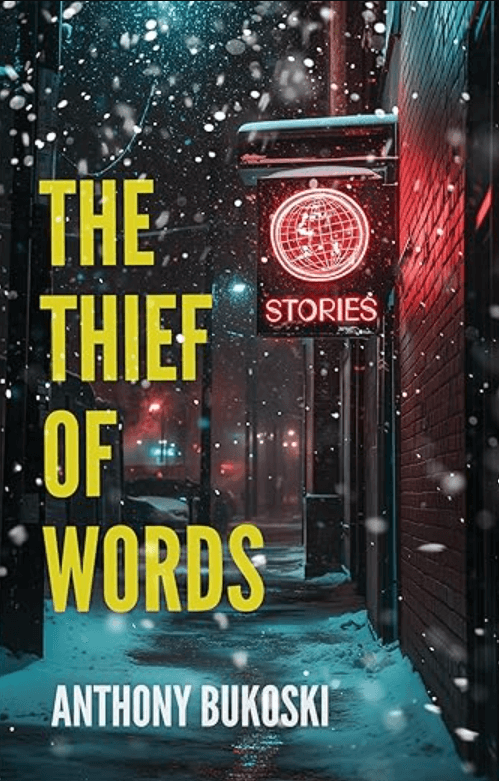
I met Anthony Bukoski about ten years ago when he was keynote speaker for a gathering of the Lake Superior Writers organization that serves northern Minnesota and Wisconsin. Although I’d published only one or two books, he knew who I was. Since then, we’ve kept track of each other’s careers. Tony kindly blurbed my short story collection, The Path of Totality (Cornerstone Press 2025), and I attended the recent launch of his eighth collection, The Thief of Words (University of Wisconsin Press 2025).
Bukoski grew up in Superior, an industrial city on the shore of Lake Superior. After serving in the Marine Corps from 1964-1967, he earned a B.A. in English at Wisconsin State University Superior, then later a Ph.D. in English from the University of Iowa. After teaching in Louisiana, he returned to his hometown to teach at what was by then the University of Wisconsin-Superior where he is professor emeritus.
His stories feature white collar-blue collar tensions that belie his time spent in both worlds. The Thief of Words focuses on such themes as loneliness, longing, dislocation, assimilation, and generational conflict.
Rachel Swearingen’s 2022 Hypertext interview with Bukoski lists the author’s publishing credits and discusses The Blondes of Wisconsin (UW Press 2021). I’ll repeat only a little of that, as there is much to say about his new book. Let me note that Bukoski’s books have been reviewed in Publishers Weekly, Kirkus Reviews, The New York Times Book Review, and elsewhere
For this interview, I travelled not far from my home in Duluth, Minnesota, to meet Tony on the patio of a restaurant on an island in Superior Bay. We had the place to ourselves on a summer afternoon.
Marie Zhuikov: Compared to The Blondes of Wisconsin, the narrative flow in The Thief of Words seems more free-form and intuitive. Was that intentional?
Anthony Bukoski: I’ve wondered whether beginning The Blondes the way I did was a good idea. In “Tributaries,” a rural mail carrier drives the same roads year after year. When he returns home at the end of the day, his children hardly notice him.
In subsequent stories, the isolated protagonists are again controlled by external forces and virtually speechless. For instance, in “The Six Purposes of Drill,” recruits at Marine Corps Recruit Depot San Diego require a drill instructor’s permission to speak.
This tendency toward silence ends when the love stories about the tenth-rate boxer and the cook on a Great Lakes freighter begin. The Blondes of Wisconsin won the Edna Ferber Book Award and was one of three honorees in the annual Society of Midland Author’s Award competition. Perhaps sometimes a book is better for its shortcomings.
Anyway, compare the above stories to “King Creole,” the first story in The Thief of Words where eighteen-year-old Earl Slinker lives in a boxcar. When not working on a highway road crew, he’s his own boss. He plans to travel, meet women, be a rock and roll singer. Whereas the first stories in The Blondes employ omniscient narration, “King Creole,” a road story set in the early 1960s, uses first-person narration. Accompanying Earl in a boxcar bound for New Orleans are Doris Koss, a middle-aged schoolteacher who thinks she’s Blanche DuBois, and Wallace, a boy with a skin disease he believes is leprosy. Nothing inhibits their speech, behavior, or movement
Forget form matching content and all that. A writer must engage readers from the start. I’m not sure I did this in The Blondes of Wisconsin.
I noticed that in “King Creole,” the Doris Koss/Blanche DuBois figure gets escorted from the French Quarter by Tennessee Williams, whom you bring to life.
Tennessee Williams is one of my literary idols. His picture graces our living room. Why not come as close as I can to meeting him by having Mr. Williams reclaim Blanche from Earl Slinker, who in some ways is the alter ego of his creator, Tony Bukoski? I appropriate a famous playwright’s character; and in the act of returning Blanche to him, as it were, the playwright and I meet on a foggy night in the French Quarter.
The story took thirty-five years to write. I got the idea when I was teaching at Northwestern State University of Louisiana. Our friends W. P. Kinsella and his wife visited us in Natchitoches. Bill, Ann, my wife, and I had been friends at Iowa before he was famous for writing the novel that became the movie Field of Dreams. Anyway, I told him I was thinking of a story that would begin, “She [Blanche] was known all up and down the River Road.” This famous road follows the Mississippi and passes antebellum plantations on its way from Baton Rouge to New Orleans. Bill was excited about the idea. I kept a note in my desk: “Write Blanche story.”
Over the decades I’d think about the story. I finally began it in 2018 or 2019 when I met someone who seemed a perfect physical manifestation of Blanche DuBois. Though I’d never modeled a character’s looks so completely on an actual person, this gift was presented to me, and I took advantage of it.
“The Beauty of Desire” starts off right away with crazy, unrestrained things like somebody wearing a helmet and bouncing on a trampoline. When I began to read it, I was like, “What is going on here?!”
As part of her job caring for Miss Desiree, a once elegant Southern woman, the Polish housekeeper must wear an LSU football helmet and bounce on a trampoline. In Louisiana, my wife and I had the opportunity to visit this charming lady with two of our colleagues. As much as we liked Miss or Miz Desiree, her name in the story, we didn’t care to give up Sunday mornings, but our Georgia colleagues insisted we join them. Miz Desiree was something! Newspapers lay scattered on the bed in her apartment. A painting of Robert E. Lee’s horse “Traveller” hung on the wall.
I saw the trampoline in another room. Eventually, Miz Desiree told us the housekeeper would position her in a wheelchair before the trampoline. As the housekeeper bounced, the old woman—in great spirits as she divulged this—insisted she received waves of kinetic energy through the tile floor into her legs. It was nuts! Southern Gothic becoming real before our eyes.
Whereas the above account is true, I made up much of the rest, the helmet, for instance, or the material about Ula (“Oo-la”), the housekeeper. “The Beauty of Desire” occurs during the Miss Louisiana Pageant. The professor’s wife in the piece grows jealous of her daughter’s participation in the contest, jealous of that and of Tissy’s affection for her rotund father, who’s enamored of the maid. As TV viewers around the state watch Tissy win the competition, Gail, the wife, attempts to seduce her husband by lifting her skirt and performing a kind of cancan, after which the professor learns that his dipsomaniac wife wears an adult diaper.
The crazy thing is some of this is true. I’ve been lucky. I don’t have to look very far for stories. They come to me. All it takes—though sometimes over many years—is to order and craft the material, which is something I’ve devoted my life to.
I hadn’t heard about Polish displaced persons like Ula Sczypanska.
Not many people know about Polish Americans in general, except of course through the jokes that Carol Burnett, Burt Reynolds, Robin Williams, Meryl Streep, Jimmy Failla the FOX comedian, and many others have told and will continue to tell without repercussions. Despite the teaching of multicultural literacy in schools, no one learns about Polish people, let alone the plight of the DPs in Louisiana and elsewhere. In fairness, I must bring up Flannery O’Connor. She and her mother had DPs working on Andalusia Farm. O’Connor writes about them in the sad and beautiful story, “The Displaced Person.”
In the old country, Urszula Sczypanska and family had been uprooted during World War II. Under the aegis of the Displaced Persons Act, they, like other central and east European DPs, were resettled in the United States, in the case of the Sczypanskas, on a sugar plantation. In addition to the trampoline story, Ula appears, or is referred to, in “Star and Star Lover” and “Lonesome, Ornery, and Mean.” Earl Slinker, King Creole, is the son of DPs who travel north to Wisconsin.
More than just the Poles are culturally and psychologically displaced or out of place in your stories. This is one theme you return to, others being poverty, illness, the longing for something better, and Catholic faith.
I’m glad you noticed. The woman who becomes Blanche keeps losing high school teaching jobs because of “moral turpitude.” The sick boy Wallace, her traveling companion, quits high school after his sophomore year. Joe Bluebird, a Native American from the Bad River Indian Reservation, rarely interacts with white workers at the flour mill in “Chokecherries.” In “English 110,” Miss Kobiyashi, an older college student from Japan, feels out of place in Superior. In the final story, “A Sea Story,” a large Polish family meets one summer evening to eat, drink, and talk about the past and present. With Chopin and Paderewski playing on a phonograph in the lush summer garden, the family finds peace for the evening. “The stories of czars and princes led to other stories” before they go in for the night. With the reunion, the book ends on a somewhat positive note.
You seem unafraid to use Polish names, words, and phrases, although the consonant combinations will look strange to readers. Consider Ula’s last name.
In earlier books, I may have overdone the Polish. I’ve cut way back in The Blondes and The Thief of Words. I hope the consonant clusters plus the diacritical marks of the Polish language catch the reader’s eye, such as when Mrs. Nowicki in “Forget-Me Not” whispers to herself, Miłość karmi sie nadzieja . . . Hope keeps love alive.” How characters speak, what they look like, what they eat, what they do with their spare time, all are important.
You also shed light on the World of Accordions Museum. In my research, I saw that you did a reading there.
The museum is highlighted in “A World of Accordions.” In my beloved hometown, we have the largest collection of accordions in the world. Can you imagine! AWAM publicity calls the collection “the Magnificent 1,300.” Helmi, the owner, has added more accordions, so it’s now “the Magnificent 1,300 plus.”
Long ago, after his passing, I gave Helmi my dad’s accordion and some sheet music. I think of him when I present programs at AWAM. In the story, which I’ve read twice there, an insurance agent named Murawski comes to the dock to watch a Polish freighter load grain. That evening, a Polish immigrant happens to be there. He plays Count Ogiński’s moving “Farewell to My Country” on the accordion. Two Poles watch the departure of the Ziemia Białostocka for a country to which neither will return. Mr. Murawski insures the building that houses “the Magnificent 1,300.” How can he insure the aging accordion player against memory?
By the way, my father would haul out his accordion after supper and practice at the kitchen table. Every night it was, “Hoop-Dee-Doo Polka,” “She’s Too Fat Polka,” “American Patrol,” and others. It drove me nuts! When I’d close the door between the kitchen and television room, he’d open it, ostensibly to let air flow through the house. By opening the door, he was also saying, “My playing is from the heart. I’m playing this for you.” Good old Joe Bukoski, former seaman, now millhand and jack-of-all-trades, walking to King Midas Flour every day to breathe in the dust, Joe Bukoski and his lunch box. He appears in the title story of The Thief of Words, a story Hypertext Review first published in Fall/Winter 2023.
Does the title story “The Thief of Words” refer to a lack of communication in a family or to the dementia that steals the father’s mind?
The story concerns how the father couldn’t talk much in the mill with its serenade of pumping pistons and that huge menacing conveyor belt whirring non-stop. He has to do his talking and storytelling at home where he also corrects his children’s speech. My own father remained vigilant concerning our vocabulary and pronunciation. In the story, dementia robs the father of his words. (My father died of lung cancer, not dementia.)
At one time you feared you’d reached the end of your writing life. Why didn’t you give in? What happened?
Long before my good fortune with the UW Press, Southern Methodist University Press, my beloved publisher for eighteen years, closed. For that and other reasons, I began to wonder why I was writing. Around that time, I’d had a few stories accepted to get me through. Then while out on a walk, I met someone whose intellect impressed me. We met again and talked about literature. She inspired me so much that I acknowledge her in The Thief of Words.
My good, patient, steadfast wife is my first inspiration. This thing with the walking partner, though, had never happened to me before. I’d found a model who seemed the perfect physical manifestation of a character. After my joy in the discovery, we didn’t meet again for four or five years. Now and then, we corresponded. She inspired more than just “King Creole.” When I’d feel as though a story was going nowhere, I’d think of the newcomer to my life, her sensibility, and what I hoped she expected from me as a writer. Since then, I’ve both appreciated and depended upon her kindness.
Sometimes all it takes is an audience of one.
Nicely said, Marie.
Is “King Creole” the longest story you’ve written?
Yes. It was 128 pages, then seventy-two. I may have cut more; I don’t recall. It’s only fifty-two pages in the book. I like revising and cutting. A character named Bruno Slinker appears in The Blondes of Wisconsin, by the way. His son is one of the boxcar travelers in The Thief of Words. I wanted to use the last name again. It’s suggestive of something unhealthy, of someone hanging about the edges. Earl Slinker’s not a bad kid, really.
Can you offer advice about craft to other writers?
A mentor long ago complimented me for risking self-exposure. The writer Frederick Busch, on the other hand, cautioned me against too much self-analyzing in a story that is autobiographical. He said, wisely, “Writing is about art, not about making yourself feel better.” Who knows? The best advice? Keep going.
Did you risk self-exposure in the story “Forget-Me-Not?”
I did. In the piece, a Navy corpsman creeps into a tent of sleeping marines and rubs his hands over one of them. By the time the corpsman returns another night, Lieutenant Schirra has been alerted to this strange thing. A plan is developed to catch the interloper.
In actuality, it was a strange, moody, atmospheric time—the heat, the jungle, the war, the night visitor, the longing for home and love. A few days later, I accompanied a member of the platoon as we drove the corpsman in a jeep from our outpost to the brig on the DaNang Airbase. He was to be flown stateside, court-martialed, and dishonorably discharged. I read his typed confession. Earlier in the story, a Polish private from Superior finds himself at night in the communications tent with the corpsman. My girlfriend from back then was somewhat distressed when she read the story a few months ago. “I wasn’t the character,” I told her.
In ending our interview, let me ask why you chose Psalm 25 as an epigraph to The Thief of Words. Are the stories a confession of the sins of your youth?
Yeah, the stories are partly about me. I know a little about boxing, which I write about in The Blondes of Wisconsin. I know about the Marine Corps. I know about the East End of Superior, the sisters who taught me at the Polish school and whom I revere. I know, for instance, that I’ve been a sinner. If you know about things, why not use them to lend verisimilitude to your work?
I should probably mention that I do kickboxing workouts, and I wear pink gloves.
You do? Well, why didn’t you tell me. I wouldn’t have been so smart. I’d have kept my hands up, chin down, elbows in, and moved away from your power punch.
Once the interview is over, Tony asks me to stand. I wonder if he wants to hug me or something. But no, he gets into a boxing stance, showing me how he protects himself. He encourages me to get into my stance. I do so, wondering if a seventy-nine-year-old and a sixty-two-year-old are really going to spar on a restaurant patio with bare hands. Without warning, he jabs at me, purposefully missing my face. I jab back but then feint a roundhouse kick to his thigh. Surprised, he drops his hands to protect his leg. “That got my attention!” he says. As we leave the restaurant, I realize the author is as unrestrained as his stories.
Marie Zhuikov is a fiction writer, poet, blogger, and photographer. Her short stories and poems have appeared in several anthologies and community projects. Her blog-memoir, Meander North (Nodin Press), earned a 2023 silver Midwest Book Award for nature writing. She is, as previously noted, author of The Path of Totality and two novels.
Zhuikov has a B.A. degree in science journalism and an M.A. degree in health journalism from the University of Minnesota. She is a science communicator emeritus for the University of Wisconsin Sea Grant Program. For more information, visit marieZwrites.com.
Anthony Bukoski has published eight short story collections. A Booklist Editor’s Choice, Time Between Trains was chosen as one of the best fiction books of 2003 for public libraries. The actor Liev Schreiber read the title story to a live audience at Symphony Space in New York City. Bukoski’s stories have appeared in New Letters, The Literary Review, Western Humanities Review, Image, Quarterly West, New Orleans Review, and elsewhere. His work has been recognized by the Christopher Isherwood Foundation, the Polish American Historical Association, the Council for Wisconsin Writers, and the Wisconsin Library Association. In addition to the Ph.D. from Iowa, Bukoski has an A.M. degree from Brown University and an M.F. A. from the Iowa Writer’s Workshop. He is a life-time member of the National Book Critics Circle.