

Interviewed by Alex Poppe
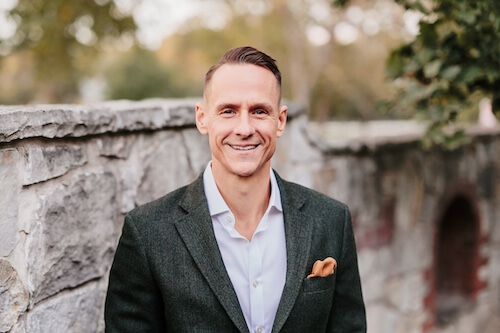
A phoenix burns itself into ashes upon its death and is reborn from those same ashes. The same is true for Tim Hillegonds, the author of the hauntingly uplifting new memoir And You Will Call It Fate, published by the University of Nebraska Press on March 3, 2026. The reader accompanies Tim on his journey from high school dropout, struggling addict, and estranged father to sober, accomplished writer. Along the way, Hillegonds challenges the reader to contemplate gratitude and obligation, especially when those who help us also harm us.
Alex Poppe: Early in the memoir, you write, “I wanted everything, anything, all the things that would make the world shrink and lose its texture.” Do you remember the first time you had that desire? What had precipitated it? You write that you were a teen inline skater who had turned pro. Did you want to shrink the world even then? What was being a pro inline skater like?
Tim Hillegonds: In my first book, The Distance Between, I wrote about the years that I spent as a professional inline skater, and those years are still some of the fondest memories I have of my youth. It was before alcohol and substances had really found purchase in my life. The days I would spend performing in front of those crowds of people, inhabiting a body that felt like it could do anything, front flipping over cars, feeling the pulse and beat of the music flooding through me while the crowd cheered, were days that I hoped would never end.
Back then, I didn’t want the world to shrink and lose its texture, no, I wanted it to grow larger and more expansive, to take me to all the places I’d dreamed of going, to deliver me to the life I’d always wanted, one where I didn’t have to think about the father who’d left me or the school that had expelled me. But after, when the skate team had fallen apart, when my teammates began going off to college, I was left with a reality that I didn’t want to face, or maybe didn’t know how to face, which was that this dream I’d had of skating professionally was over.
It was after that, when I had to confront the truth of where I was, which was essentially stuck, and with no real plan, that alcohol and substances began to play a bigger role in my life. Over the years, I’ve thought (and written) a lot about how I became an addict and alcoholic. I know the driving forces are familiar ones—divorce, a father who left, a man trying (and failing) to figure out what “being a man” was—but the insight I keep coming back to is that my journey to addiction happened, as so many things do, and as Hemingway once wrote, gradually, then suddenly. It happened for lots of reasons, many of which I’m still unpacking, and it happened slowly, and then all at once. That’s the tricky part of substance use disorder. It’s nothing at all, until the moment it’s everything you are.
You write that Chicago was “as much a part of me as it was a place, as much DNA as destination…it was with me in every moment.” How does Chicago continue to influence your writing, how you run your business, how you continue to understand yourself?
Tim: I still feel like that about Chicago. It’s still with me in every moment. Each time I leave the city and return, when I’m in a cab headed back from Midway Airport, barreling north on I-55, rounding the turn near Damen where I first see that beautiful skyline reaching up from the concrete, it takes my breath away. It’s hard to describe how much I love this city—the architecture, the art, the accents, the food, the music, the protests, the politics, the history, the trains, the Bears, and the Lakefront Trail, where I’ve run thousands of miles at this point in my life—it’s all endlessly fascinating to me. It literally never gets old. Chicago is my first love, to be sure, however, I’m old enough now, and I’ve read enough now, to know how problematic this city is, too, and how my experience is one very white, very privileged, very male perspective. It doesn’t make me love the city any less, but it does allow me to see a fuller picture and take a more nuanced view.
Writers often write about New York, and New York certainly plays an outsized role in literary lore, but Chicago is an if-you-know-you-know sort of thing. Chicago writers are different. We bring a distinctive sensibility to our work, a lunch-pail and hard-hat work ethic that’s unique to the Midwest. I think if you read Stuart Dybek or Megan Stielstra or Gwendolyn Brooks, you’ll see what I mean.
It’s also a wonderful, entrepreneurial city with world-class academic and medical institutions, and a rich, vibrant, and burgeoning tech scene. In addition to being a writer, I’m also the founder and CEO of a health-tech start-up called RecoveryAI that’s using artificial intelligence to interrupt and prevent relapse in people with substance-use disorder. In fact, the entire business was inspired by a moment I write about in the book, where a brief and unexpected interruption in my pattern of thinking saved me from relapse. Chicago is a wonderful place to build a business like that, and it’s my hope that I can give back to the city in some of the same ways it’s given to me.
Dempsey’s anger overshadows the book. In retrospect, did you recognize the red-flag behavior as it was happening, or did you need the perspective of distance to help those red flags come into focus? How did your management of his anger change after you had completed rehab? You quote Dempsey as saying, “When it comes to sobriety, you have to give it away to keep it.” After twenty-plus years of your own sobriety, how do you understand what this means?
I knew his behavior was problematic from day one, but it was also entertaining, at least in the beginning, and who was I to tell him how to behave or how to run his business? And really, what was I to do? Dempsey gave me a shot at a real life, a real career—which felt like the only shot I would ever get—and dealing with his anger seemed a small price to pay for that. Even now, after everything, it still feels like I got more than I gave.
In terms of that quote about sobriety, I think it has its origin in the fact that the ultimate antidote to self-obsession, which is at the core of all addictions, is service work—getting outside yourself and helping someone else. When you give of yourself, when you engage in helping another person, you inadvertently help yourself. That’s what Dempsey was getting at back then. It took me years to figure that out, but he was exactly right.
Wanting to “nurture that destructive part of myself” is relatable if not universal. What advice do you have for readers who are tempted to act out on this impulse? Sometimes, we are not able to hear what our inner self is telling us, especially when it comes to pursuing what we really want. You write, “Sobriety, the gift I’d been given, which I had just discovered I wanted.” What advice do you have for readers who are struggling to figure out what they really want to pursue in life? Who are struggling to hear their inner voice?
The two most powerful lessons I’ve learned in recovery are these: be still and be uncomfortable. Change is a process that often stems from moments of discomfort—when the pain of staying the same becomes greater than the pain of change. And the only way to change is to learn to be in that moment of discomfort for as long as it takes for the change to occur. It’s not easy, but it’s necessary.
As my life has unfolded, I’ve come to learn that moving towards the discomfort is almost always the right thing to do. And sometimes that discomfort can lead to stillness. And finding stillness in one’s life, even in those moments of discomfort, or especially in them, is what allows one to truly hear that voice inside, the one we’re often distracted from, the one the world nearly drowns out with all its noise. Finding that voice and hearing what it has to say can be incredibly instructional and liberating. It’s also the point, I think, to spend your life finding moments of stillness and presence that allow you to feel your existence, your purpose in all its wonderful complexity.
You describe wanting to become “a bigger, tougher man.” How much of Dempsey’s behavior did you adopt during those years you worked for him? Did you find yourself lashing out at others as he did, and if so, did that behavior abate when you stopped working with him?
I certainly absorbed some of his tendencies, but not to the same degree. I’ve struggled with anger throughout my life, and with having outsized reactions driven by emotion, especially in my youth, but much of that stopped once I got sober—and as I’ve gotten older. Not all at once, and not completely, but over time, it has diminished greatly.
Once sober, I began dealing with the root of my anger, which was really just the pain I felt, and the disappointment, of becoming who I’d been. I’m still trying to become more equanimous and less reactive. It’s a lifelong endeavor, though, but it’s one that sobriety and meditation have helped me with in big and substantial ways.
You write that “fighting in the ring and fighting to become a different person, a different man, were nearly the same thing.” Could you unpack that a bit? How are they the same? Also, did you ever compete in another Golden Gloves? If so, how did that go?
When you’re in the ring with another person, you have to walk toward the fight, towards the unknown, towards the danger. You have to put yourself in a position where you’re exposed so you can land shots, and, inevitably, you’re going to get hit. It’s just part of it. You have to stay calm, try to remember your game plan, look for openings, and strike when you can.
That feels to me like what it’s like to try and become a different type of man, especially in a hyper-patriarchal society that views masculinity primarily in one way. It’s hard to be a different man in a room full of men who are not interested in hearing about that sort of thing. It’s hard to look at yourself over and over, finding your faults, interrogating your actions, trying to be better. But you have to be willing to do it anyway, to put yourself out there and be exposed, to stick to your game plan, even though you might take some shots, by which I mean, be excluded, or ostracized, or not accepted. Boxing taught me that I can take it, that I’m durable, that no matter what kind of shots come at me, I can bite down on my mouthpiece and keep moving forward.
I had so much empathy for this line: “{Boxing}had unexpectedly given me a portal into my truest self, into the parts of me that I liked the least.” Why did you consider the parts of you that you liked the least your truest self? How has that perspective shifted over time?
I’m an emotional guy who’s not very tough. Fear makes my voice shake. I don’t like to fight. I cry too often and feel too much. I like rom-coms. I’m sentimental. I have a deep sense of empathy. I’m driven by guilt. All of those things are in conflict with traditional ideas of masculinity, and they felt like things I needed to confront. Boxing allowed me to challenge all those traits in a way I simply couldn’t through any other means. It allowed me to see what I was made of, to examine it, to view it without distortion.
What I learned, or, rather, what I’m still learning, is that it’s perfectly okay to be like that, and even to be a man like that. I can define masculinity however I want. I still find it incredibly difficult, but I’m learning to accept and like who and how I am.
There is a significant episode of gaslighting at the end. You write that you were stunned and realized that what could be fundamental for one person could be a shoulder shrug for someone else. What did you learn from unpacking that moment when writing this book?
I learned that everyone is right from their own perspective, and that nothing is as good, or as bad, as I think it is. These moments in our lives can feel so consequential, and so important, and maybe they are, but they’re also stories we tell ourselves. And these stories can define us, especially when we tell them over and over.
I think what I’ve learned is that I can control that narrative much more than I originally thought. I also think that’s what Carl Jung’s quote (where I pulled the title from) was getting at. Unpacking that moment in the book was making the unconscious conscious, so it would no longer direct my life.
I am haunted by this passage: “Was it abusive? Maybe. But even if it was, it was an abuse I felt I deserved, and an abuse I think I needed. I’m not sure I would have responded to anything different.” Why do you think you responded to something hard/angry and not something like grace?
That’s a tough one to answer because we all respond differently to situations like these. What I can tell you is that no one was going to be able to love me into a different person. (Lord knows my mother and stepfather tried.) No amount of love or grace was going to get me sober. I needed to be met with aggression, to know in no uncertain terms that the world didn’t revolve around me and there were forces out there that could annihilate me, metaphorically and physically. I had to learn that there were consequences to my actions that could be far worse than I thought they could be. I had to feel a sort of fear that I hadn’t felt before. Dempsey was bigger, stronger, and meaner than me, but he was also generous and loving and kind at times, too. For reasons I may never know, it was the perfect combination for me.
Timothy J. Hillegonds is the author of And You Will Call It Fate, A Memoir (University of Nebraska Press, March 3, 2026) and The Distance Between: A Memoir (University of Nebraska Press, 2019), a finalist for the 2020 Chicago Writers Association Book of the Year Award. A Pushcart Prize nominee, Tim’s work has appeared in The Guardian, the Chicago Tribune, Salon, The Daily Beast, The Los Angeles Review of Books, and elsewhere. He serves as a contributing editor for Slag Glass City, a digital journal of the urban essay arts. Hillegonds lives, works, and writes in Chicago. www.timhillegonds.com
Having worked in conflict zones such as Iraq, the West Bank, and Ukraine, Alex Poppe depicts fierce women rebuilding their lives after violence. She is the award-winning author of four books of literary fiction and Breakfast Wine, a memoir-in-essays, recently named a first runner-up for the Eyelands Book Awards and a finalist for the Chicago Writers Association Book of the Year and the American Writing Awards. Alex’s work has appeared in The New York Times, Literary Hub, HuffPost, and elsewhere. www.alexpoppe.com