

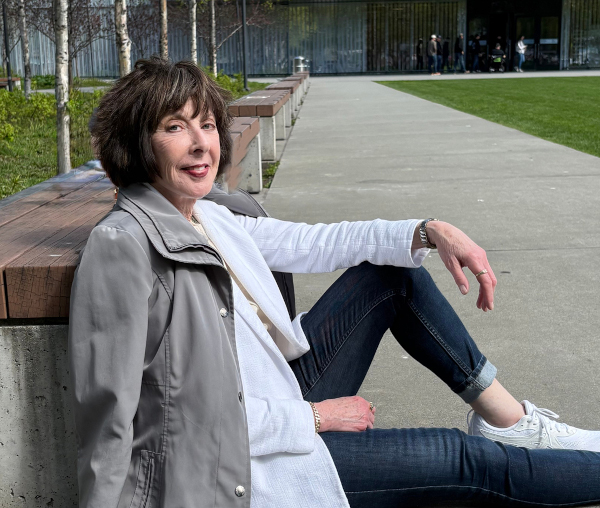
Interviewed by Randy Richardson
Samantha Hoffman and I met at a romance writers’ conference in 2012, an unlikely place for two writers who aren’t, and never were, romance writers. We bonded over that shared sense of not quite fitting in, and over the personal experiences that had inspired our fiction. That year, Samantha’s debut novel, What More Could You Wish For?, had been published by St. Martin’s Press. My own novel, Cheeseland, had also just been released. Both were coming-of-age stories rooted in personal experience, though hers followed a woman turning 50 and mine a teenage boy navigating the awkward passage toward adulthood.
I was just past 50 myself when I read Samantha’s book, and it struck a chord. Her protagonist, Libby Carson, seemingly had everything she could want, yet still felt something was missing. I praised the novel’s wit, charm, and tenderness, writing that it reminded me life doesn’t have to end at 50; sometimes it can be a new beginning.
I didn’t know then that I was also beginning one of the most meaningful friendships of my life. Over the ensuing fourteen years, Samantha and I have become close friends and trusted collaborators. As vice president of the Chicago Writers Association and director of our annual Let’s Just Write! conference, she continually impresses me with her vision, creativity, and leadership. I’ve also come to rely on her as one of my most trusted editors. Her feedback is invariably thoughtful, detailed, and honest. Every writer should be fortunate enough to have someone like that in their corner.
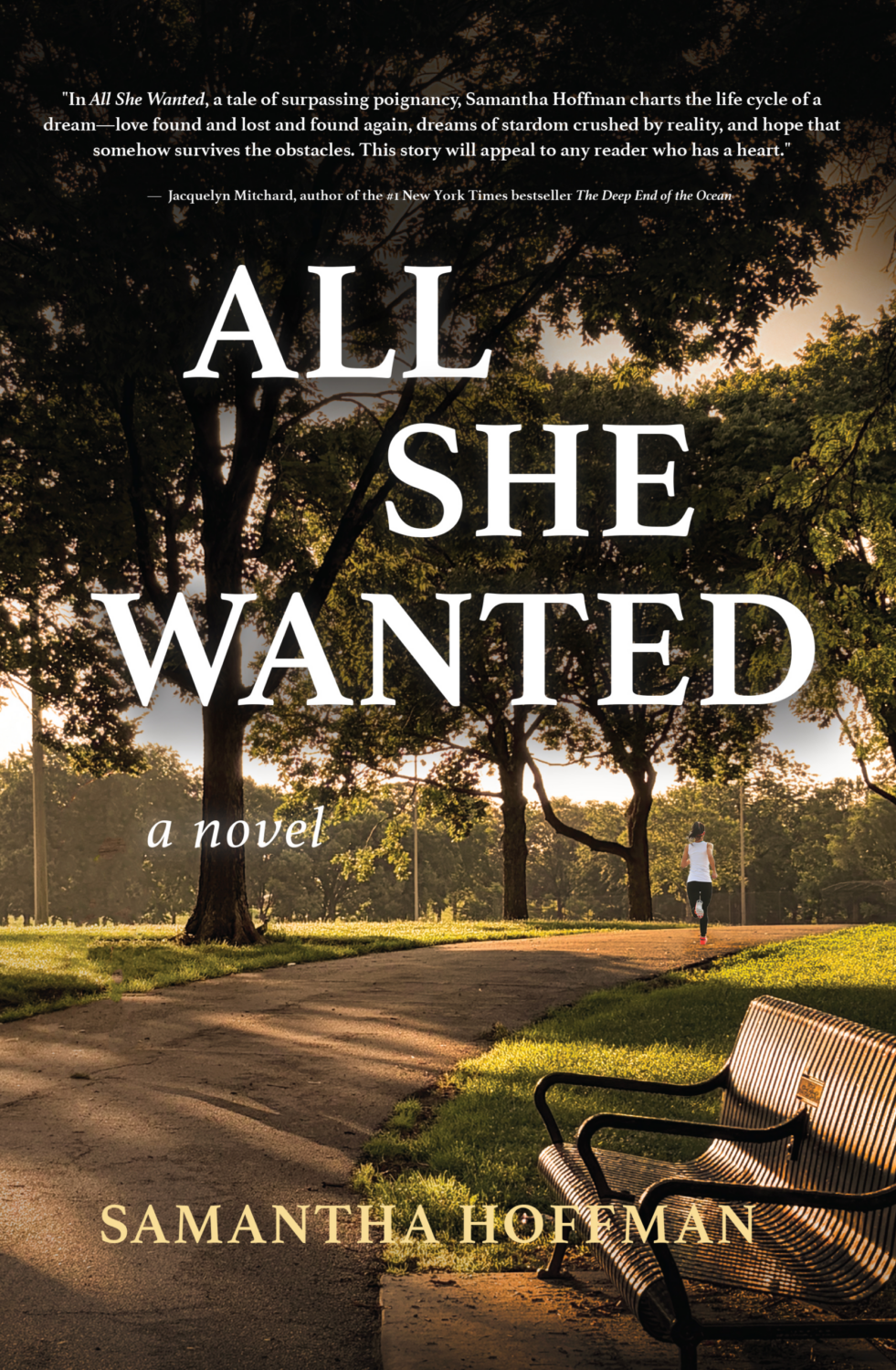
Now, fourteen years after her debut, Samantha’s second novel, All She Wanted, takes me back to that first encounter with her writing. Here again is a woman yearning for something more. But whereas Libby Carson was confronting the uncertainties of middle age, Annie Adams, her new protagonist, is just 21, navigating love, ambition, and adulthood in Chicago.
Samantha writes convincingly about a woman more than half a century younger than she is, reminding us that love, longing, and the mistakes we make are hardly confined to any particular age. Samantha, it seems, is still exploring the question that animated her first novel: What is it we really want, and will we recognize it when we find it?
Samantha lives in Chicago’s Gold Coast neighborhood with her beloved cat, Bailey, who frequently steals the spotlight on her social media pages. We recently exchanged emails and texts about her new novel, the fourteen years between books, and what she’s learned along the way.
Randy Richardson: The titles of both of your novels suggest characters yearning for something more: Your first novel What More Could You Wish For follows Libby Carson as she confronts a kind of coming-of-age at fifty, while All She Wanted follows 21-year-old Annie Adams as she begins figuring out who she is and what she wants from life. Do you see these as companion stories in some way, i.e. women at very different stages of life asking versions of the same question?
Samantha Hoffman: I didn’t think of All She Wanted as a companion story while I was writing it, but now that you’ve pointed it out I rather like the idea that Annie might be the younger Libby. I almost wish I had thought to write it as a prequel. There are connections between the two stories and the two women that I can see now, that might have played well into interconnected novels.
Annie could easily be Libby as a young woman. There is a thread that links them – their hopes, their vulnerabilities, the choices they make. So I can see how you made that connection. And by the way, thank you for reading my work so thoughtfully.
Both books revolve around romantic relationships, but neither feels like a conventional romance novel. Love—or the pursuit of it—seems to be more of a vehicle for exploring identity, choices, and self-discovery. How do you think about these books in terms of genre? Are they love stories, or are they really stories about women learning to understand themselves?
They are not traditional love stories but I believe that love is central to all of our lives so, for me, it would be difficult to write a story where there are no significant relationships. They might be, and often are, love interests but they can also be family relationships, friendships, rivals or adversaries, sometimes even strangers. It is through our relationships with other people that so much of our lives unfold. I see love as being essential to defining who we are and who we become. For me, that’s where the heart of a story lies. So, your description of love as a vehicle for self-exploration in my books is exactly how I view it, as a jumping off point for growth and understanding.
As for the genre that I think my books fall into, I consider them contemporary fiction. Some might call them women’s fiction and I don’t mind that. However, I feel that putting books into that specific category limits the audience and I think my work would appeal to men as well as women.
On your Substack, Writing and Running, you’ve written about how the laundry-room encounter that opens All She Wanted was inspired by something that actually happened to you. What was it about that moment that stayed with you and eventually made you think, There’s a novel here? And what does the real-life man who inspired that encounter think about being transformed into fiction?
I always thought the way I met my first husband in the laundry room was charming and romantic. At different points in my life, I imagined there might be a novel in that story somewhere. I just never knew what the story was.
The inspiration for All She Wanted began taking shape during the #MeToo movement, when public conversations about sexual misconduct, accountability, and cancel culture were at their height. At the time, I found myself thinking we had gone too far, as Americans sometimes do when a conversation gains momentum. I was troubled by what I saw as a lack of nuance and, in some instances, unfairness toward men who were having fewer and fewer opportunities to respond. I wanted to tell a story that looked at that imbalance. There was never an intent to excuse anyone’s behavior. I just felt there was a need to question our perceptions and have a conversation about responsibility and judgment.
The chance meeting in the laundry room turned out to be my way into that story and not the story itself.
I think most people would be intrigued to discover that a memorable moment from their own life became the seed of a novel, and the real-life man is no exception. He’s actually quite flattered. He does understand, however, that what happens in my novel is very much fiction, that I’ve taken that small moment and built an entirely different story around it, with characters and circumstances that only belong to Annie and Charlie.
There seems to be quite a bit of you in Annie Adams. How much of her comes from your own experience as a young woman, and where do the two of you diverge? Annie begins the novel as a somewhat naïve small-town girl who arrives in Chicago and quickly discovers that adulthood—and the big city—are more complicated than she imagined. How much does her transformation reflect your own coming of age, and what did you want her to learn about herself over the course of the novel?
Like Annie, I left home at twenty, trading Toledo for the big city of Cleveland. I also moved in with a young woman I barely knew, but the only other similarities between Annie’s story and mine are the meet-cute in the laundry room and the fact that we both worked in a bank.
Unlike Annie’s roommate, mine was exactly as kind and generous as she seemed. We became friends, stayed in touch for many years, and I always knew her to be a genuinely good person.
What I drew from my own experience was the feeling of leaving home at twenty and suddenly being responsible for myself. There I was, on my own in a new city, making decisions for myself and figuring out who I was going to be.
Fortunately for me, I didn’t make questionable decisions that adversely affected someone else’s life, so that’s where our experiences diverge. Annie’s independence becomes complicated by the choices she makes and the people she trusts. That part of her journey allowed me to draw on an emotional experience that was very real to me, even though the circumstances were entirely fictional.
I think writers often do that. We borrow the feelings from our own lives and give them to characters whose lives may look nothing like ours.
Annie is 21, but you’re writing her story from the perspective of someone with many more years of life experience. How did you put yourself back inside the head of a 21-year-old—the uncertainty, impulsiveness, and intensity of that age—without allowing the wisdom of your older self to intrude on her point of view?
I think the key was remembering that Annie didn’t know what I knew. I had to resist the temptation to let my own hindsight creep into her decisions. At twenty-one, you can be intelligent and thoughtful and still make choices that, from a distance of many years, seem completely avoidable.
I thought about what it felt like to be young and believe you understand a situation when, in fact, you’re seeing only a small piece of it. At that age emotions feel enormous, and the people you trust can have tremendous influence over you. You don’t yet have the accumulated experiences that teach you to pause, question your assumptions, or recognize patterns.
I also reminded myself that Annie had to make the decisions that made sense to her in that moment, with the information she had and the emotions she was experiencing. If I allowed my own wisdom to guide her, I would have taken away what makes her human.
And as a writer, I had the luxury of having Annie make terrible decisions because that’s when a story gets really interesting for the reader.
All She Wanted enters some provocative territory in its treatment of #MeToo and what Charlie describes as a culture in which “being accused is the same as being guilty.” Much of the public conversation has understandably focused on women whose accusations were ignored or dismissed, but your novel also asks readers to consider what happens when an accusation isn’t true, and the damage that can be done before the accused has any opportunity to defend himself. What made you want to explore the issue from that less commonly represented perspective?
I’ve watched the increasing tendency toward excess in American culture. Everything seems to be bigger, louder, and more elaborate than it needs to be: super-sized meals, enormous houses, standing ovations when ordinary applause would do, and an almost instinctive urge to take things to the extreme. As a society we don’t seem to know when enough is enough.
I felt that particularly strongly at the height of the #MeToo movement. The movement had brought important issues into the open and given women a voice, but I began feeling that every situation was being viewed in absolute terms, deciding who was the victim and who was the villain before all the circumstances were explored.
I found myself thinking about the men who were being judged publicly and, in some cases, being reduced to the worst thing they had ever done or been accused of doing. I can’t help wondering what happens when we stop allowing people to be complicated human beings capable of both mistakes and redemption.
That was the conversation I wanted to have through All She Wanted. I didn’t set out to write a polemic about #MeToo; I wanted to tell a story that would make readers think about how easily we can make assumptions when we hear only one side. There are always two sides to a story and if we don’t consider both sides we cannot get to the truth.
Because of that perspective, did you worry about how readers—particularly women—might respond to the novel? What kinds of reactions have you received so far, and have any of them surprised you?
I didn’t worry very much about it as I wrote it and was somewhat surprised when one of my beta readers told me that she didn’t think publishers would touch it. That was some years ago, when we were closer to the height of #MeToo, but it turned out she was right. A number of agents declined my query specifically because of the nature of the story.
Eventually, I found an agent who believed in both the story and my writing. He felt, however, that the book needed to be more commercial and less controversial. That put me in the dilemma many authors face: How much do you compromise in order to sell a book without compromising the story you want to tell in the first place? I chose to compromise. I sometimes regret that decision now, although I deeply appreciated the time and effort my agent put into helping me revise the manuscript. Despite our efforts, he was ultimately unable to place it. That was disappointing, of course, but I began wondering whether the book had simply been waiting for the right publisher.
In the end, it was my good fortune to submit the book to Orange Hat Publishing, a small press that saw the value in the story and offered me a publishing contract and, most importantly, provided the opportunity for the book to find its audience.
Annie makes some choices that have serious consequences. As a writer, how do you create characters who make questionable—or even damaging—choices while still asking readers to empathize with them? Do you feel an obligation to make your characters likable, or only understandable?
I think it’s important to create authentic characters, people who are recognizable, who reflect people we know in the real world. I believe in the fundamental good of most people, but we are all flawed. I’m less interested in creating likable characters than I am in showing that part of humanity. My characters make mistakes, live with the consequences of their choices, and, ideally, learn and grow from them. Those are the kinds of stories I’m drawn to write about.
If the Samantha Hoffman of today could sit down with Annie Adams at the beginning of All She Wanted—before she walks into that laundry room and sets everything in motion—what would you tell her? And do you think she’d listen?
Just as I would have no advice to give to my younger self when I walked into the laundry room in my apartment building in 1969, I would have no advice for Annie.
We all go through life in a trial and error exercise, making our best decisions, doing the best we can, often thinking we know everything until we understand we don’t.
Honestly, I would not have listened to advice back then, not from anyone. I don’t think Annie would either.
BUY All She Wanted AT YOUR FAVORITE INDIE BOOKSTORE.
Samantha Hoffman is a writer, a reader, an artist, film and theatre buff, world traveler, and 8-time marathoner. She is the author of What More Could You Wish For (St. Martin’s Press). Her stories have appeared in Chicken Soup for the Dieter’s Soul, Hypertext Magazine, The Corner Magazine in London and other print and online publications. She was named to New City Magazine’s Lit 50 2025: Who Really Books In Chicago, and was longlisted for the 2025 Petrichor Prize. Samantha is VP of Chicago Writers Association and Executive Director of Let’s Just Write! Chicago Writers Association Conference.
Randy Richardson is an attorney, award-winning journalist, and founding president of the Chicago Writers Association. He is the author of the Tanner Ford thriller series, including Havana Hangover and Another Havana Hangover, along with the novels Cheeseland and Lost in the Ivy, and the co-author of the nonfiction book Cubsessions. His essays have appeared in anthologies such as Chicken Soup for the Father and Son Soul and Cubbie Blues, as well as literary journals including Hypertext and Memory House. He has been named to NewCity’s Lit 50: Who Really Books in Chicago list in 2019, 2022, and 2025.