

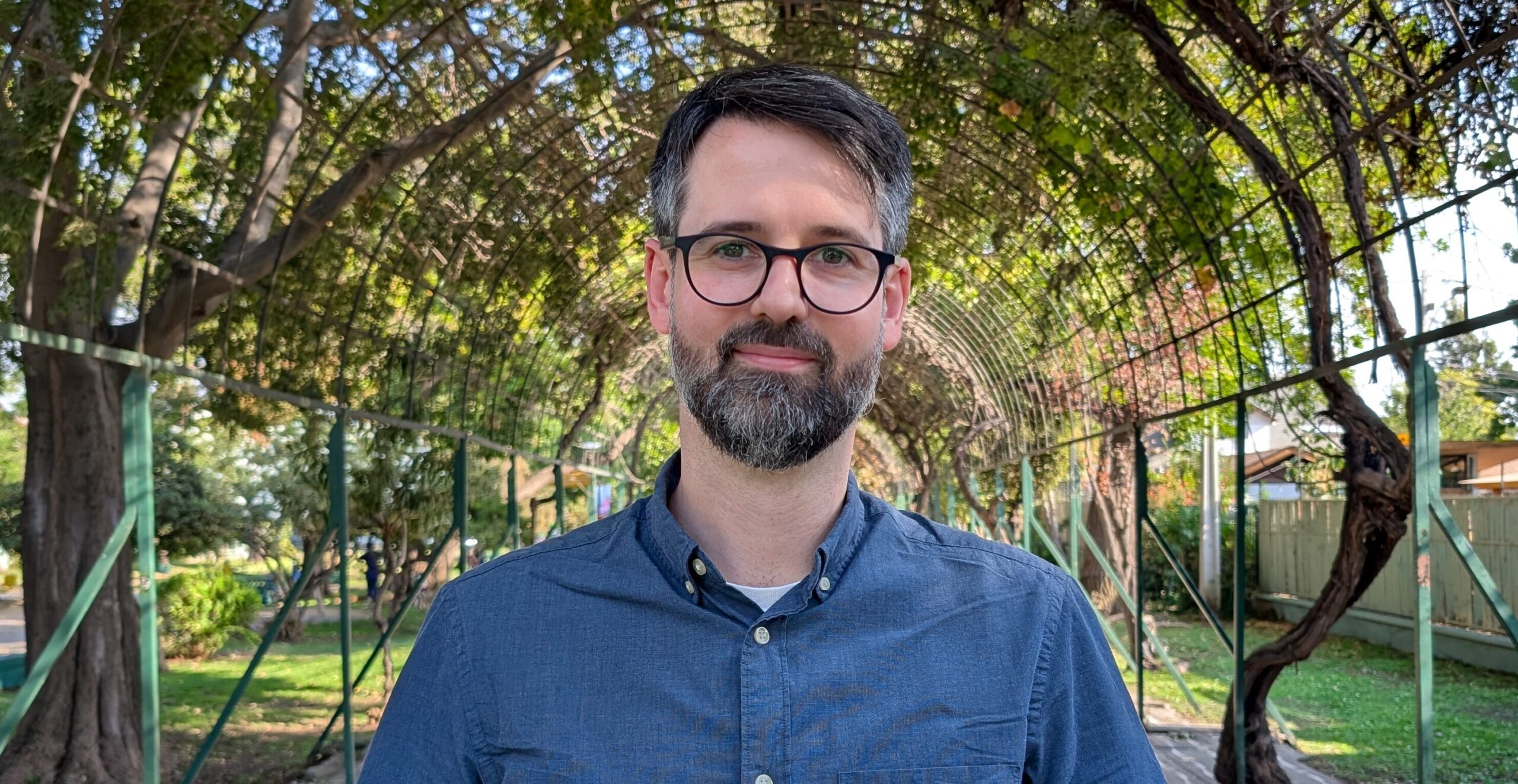
Interview by Andrew Wessels
I first read Bruce Johnson’s work in our MFA workshops at UNLV fifteen years ago, when his stories were already straining against the guardrails—attentive to sentence music, alive to place, and curious about what we can and can’t know about one another. In the decade and a half since, I’ve watched that curiosity mature: his new collection Love, Dirt carries forward the early gifts of precision of language, a feel for weather and rooms, and a stubborn tenderness, all while widening the field of risk. These stories don’t chase epiphany so much as stage the ethics of knowing and not knowing. They’re alert to inheritance and self-invention, to how a voice can care without controlling, and to how humor can surface right where seriousness gathers. There’s a privilege to getting to know a writer during the workshopping stage of their journey, watching them discover the heart of their voice and learn how to turn it outwards. And that’s particularly true for me watching Bruce’s development and discovery of the biggest truths in these stories of captured moments. What follows is a conversation between two old classmates about growth, craft, and the sentences that make a life legible—without pretending that legibility is the same as truth.
Andrew Wessels: Love, Dirt begins in Vegas, and so I’m going to begin in Vegas as well. Or, more specifically, our shared history in Vegas. I began reading your work about 15 years ago when we were both at UNLV—you in fiction, me in poetry. So let’s start, like Cheryl’s trick in the opening story “The Knack,” with where we are both from, so to speak, as authors. What’s the clearest way you’ve changed as a writer since that origin point: your sentences, your sense of what a story is, your trajectory?
Bruce Johnson: The biggest change for me has been in the writing process itself. I remember reading Zadie Smith’s “That Crafty Feeling” as an undergrad, and she makes the distinction between fiction writers who are Macro Planners (hammering out a whole plot and structure before they ever write a word) and Micro Managers (who just sit down and start writing with no clear plan, carefully constructing a piece sentence by sentence). When I first read that, I identified strongly as a Macro Planner, and that held true through most of my time at UNLV. But I’ve always felt most alive as a writer when I was in the trenches, so to speak, obsessing over individual sentences and letting the language bubble up into its final form. I don’t think I ever particularly enjoyed making extensive notes or outlines; it was just something I felt like I was supposed to do, and perhaps a means of managing my anxiety at having to start from scratch. Over time I’ve learned to trust that if I follow the language and hold true to what’s on the page then a path forward will present itself. So now I’m firmly in the Micro Manager camp, usually having only the vaguest of premises or maybe a first line in mind when I sit down to start a piece. With “The Knack,” all I had was that first sentence, and the rest just unfurled from there.
I think that approach of coming to the blank page with no particular expectation for what will come out has also led to greater variety in my work. When I reflect on the stories I was writing during my MFA—pretty much all realist stories set in the Midwest (where I’m from)—I feel quite proud of the variety of settings and modes that made it into in Love, Dirt.
I think it’s apropos, given that developmental trajectory, that the story begins in Vegas. The city where you can come to win everything, lose everything, and more importantly become someone new. And of course that you then subsequently ended up doing your PhD in Los Angeles—another city that could be described in those terms. Let’s dig a bit more into “The Knack,” which I think is a key that unlocks the collection at large. In the story, the character Cheryl is able (if and when given a fresh drink) to guess (or is it to reveal or to know?) where someone is from. As the story develops, this fun party trick becomes a multifaceted existential crisis. We’re confronted with everyone’s, and our own, performance of self. What drew you to origin as both party trick and existential pressure?
Bruce: One of the core tenets of existentialism is that existence precedes essence, that we have the freedom to construct our identity solely through our own choices and actions. I suppose I’m somewhat skeptical of that premise. There’s always a sense of starting over when you move to a new place, but surely at some level you are who you are, wherever you go. So I guess the idea of all these grown businesspeople being cut down to size by someone who is able to see through all their layers of performed identity, to their true origin points, struck me as funny as well as unsettling.
What I can’t shake from this story is that I simultaneously feel like I know where these characters are from, or at least where they are coming from, even though (spoiler alert) we never actually clearly learn that information. As I think about that, I also realize that the narrator of this story is really interesting in that he’s simultaneously unreliable in the ways that narrator characters are, but also that he’s transparent. Maybe so transparent that we see through him. When you write a character’s “from,” is it geography, biography, or feeling?
Is it a cop-out to say “all three?” I feel like those three concepts are so intertwined that it’s hard to think one through clearly without the others. I might write about a particular event in a character’s life, but how they internalize and react to that event will depend on the region they are from (and its accompanying cultural baggage). Or I might write about their hometown, but of course their relationship with it will depend on the household they grew up in. Or I could write about the feelings threaded throughout their childhood, but those will depend on how that character fit into their community and the happenstance of their family’s major life events. Of course, I don’t cram all that into every piece of characterization, but hopefully writing about any one of the three—geography, biography, or feeling—will suggest something about the other two. I suppose that’s some of what I was trying to get at with the way the meaning of the word “from” changes over the course of that story.
Because ‘from’ carries responsibility as well as biography, I’m curious about the titular story in the collection, “Love, Dirt.” In this story we’re on a rain-dark island off the coast of Chile with a father who can’t stop telling stories, a family friend named Yaco, and a teenager learning the island’s textures—colihuachos, sea wind, a wardrobe door nearly giving him away—while hearing about ghost ships and brujos. The narrator inherits two imperfect records: a father’s remembered stories and the island’s living memory. We witness what the narrator will carry forward and what he’ll leave behind. Which inherited story does he keep, which does he bury, and how did you write that decision into action rather than exposition?
As much as realist fiction tends to present stories as these tidy little things that can be recounted with 100% certainty, here and elsewhere in the collection I wanted to leave some of the inherent shagginess of narrative on display, along with some of my own epistemological skepticism. The narrator of this story is trying to sort through his relationship with his parents (especially his father), and he’s convinced that the crux of his family’s disintegration has something to do with a fight between his parents that he witnessed the tail end of some time ago. But as he narrates what he witnessed, he’s everywhere confronted with incomplete information, conflicting accounts, and details he has to fill in with his own imagination. As much as he desperately wants to assign some fixed meaning to what he witnessed and tie it up in a neat bow so he can move on, there’s a slipperiness to the experience that he can’t quite escape. Hopefully some of that slipperiness comes through in the arc of the fight, which ends with the narrator’s mother questioning his father’s narrative identity, as well as in the mode of narration, which is largely an adult trying to recount an afternoon from his adolescence, interjecting years of speculation at every turn. I’m not sure the question of what narrative will persist is wholly settled yet for the narrator, or for any of these characters.
In “The Knack,” a character knows what is hidden inside of others, at least for a time. In “Love, Dirt” a character is confronted with choosing which inheritance to believe. In “Nothing Is Ever So Simple as Zombies,” the narrator shares their supposed knowledge of what the experience of zombies will be like “if they came for real.” Throughout the collection, there is a continuous play between knowing and not knowing. What is the collection ultimately saying about our ability as readers—and our responsibility—to know and not know? Where do your narrators learn to accept partial knowledge, where do they overreach, and what did writing these pieces teach you about your own appetite for certainty versus leaving space for doubt?
I love the way you’ve framed it there—knowledge or the lack thereof as a question of responsibility. Ideally, readers feel a responsibility to read critically and empathetically. So I hope that my readers sympathize with my characters and understand where they are coming from, at the same time recognizing that any narrator’s account will necessarily include some measure of interpretation or conjecture. (I happen to think that looking at the world critically and empathetically in this way is a pretty good way to go through life, not just a good way to read.)
At the same time, there are certain narrators in this collection who seem pained or even paralyzed because they are so self-conscious about their skewed perspective or incomplete knowledge—like in “Nine Point Five,” where a son is trying to recount his father’s battle with cancer and regrets not having been there for a key moment in his father’s final days. Or in “Now Nothing,” where the narrator worries that he is committing a kind of violence by telling a story that isn’t his to tell. But I think learning to tell your own life story can be something of a survival tactic. So if some of my characters must overreach in order to do that, as in “Love, Dirt,” then hopefully that’s understandable.
As for my own appetite for certainty versus leaving space for doubt—whenever I’m writing in the first person, I try to imagine the narrator actually sitting down to write the story. When would they do so? Why? How sure would they be of their own story? Any space for doubt that I leave is hopefully a reflection of their state of mind, and I don’t begrudge them that doubt. Frankly, I think most people walk around either less certain than they appear or more certain than they should be.
We’ve lingered on responsibility, doubt, inheritance—the heavy stuff. But there’s also the weather vane of humor pointing at the same pressures: it grows from the serious or flips into it because a joke only lands if it carries truth. Think of “Now Nothing” late in the book. Its self-scrutiny is shot through with wry asides that sharpen, not soften, the ethical stakes. Several pieces thread comedy into ache. How do you decide when the joke is doing real work rather than just lightening the mood even while it is also, indeed, lightening the mood?
The humor in these stories tended to sprout up naturally from the characters and the situations they found themselves in. I never really set out to write a funny story or a funny exchange, but sometimes the humor just seemed right in the moment. And if something was funny but didn’t feel authentic, I’d cut it. I think that’s one way to make sure humor really belongs and is doing real work: it should always feel natural, never forced or contrived. And there’s so much work that humor can do! What a character finds funny—or, perhaps more importantly, what they’re too dense or self-serious to find funny—can tell the reader so much about them. And there’s a lot to be said for just “lightening the mood,” too. A lot of readers (including myself) only have so much patience for dark, dour fiction… But if you lace it with a bit of humor, you might be able to go much darker than you otherwise would have while keeping them along for the ride.
Intoxication runs through a lot of these stories, not just as booze or drugs on the table, but as altered perception, permission, and risk. There’s a lineage here (Hemingway, Carver) that your work both nods to and breaks from, filtered through a contemporary lens that’s more alert to globalism, privilege, gender, and the messiness of modern relationships. As we age and Gen Z’s stories and perspectives grow into the shared consciousness, those seem to enter the discussion here as well. What did you want to keep from that tradition, and what did you feel you had to overturn to tell these stories now?
Carver and Hemingway are certainly both big, boozy influences on me and my work. I’d add Barry Hannah to that list as well. In some ways I guess this collection is a far cry from the realist work of those writers, butin other ways I feel like I picked up almost all the tools I needed from them. They can do so much with so little, laying the whole scope of human experience bare with just a few characters having a conversation over drinks. It’s true that the conversations over drinks in my stories have perhaps a wider variety of characters and settings, in accordance with the types of lives and ideas I wanted to explore. But I view that more as a logical progression of the tradition, rather than an overturning of it. And I’ll note that I specifically had Hemingway’s “The Short Happy Life of Francis Macomber” in mind while writing the final story of this collection; I found that matter-of-fact style very instructive.
Can you talk about how you put the book together—the order, the pacing, where you placed breathers and where you stacked pressure? And tell us about one story you love that didn’t quite fit: what kept it from making this book, and does it point to what you might write next?
Finding the right order for these stories was something I struggled with a lot, actually. At one point I had convinced myself that I should expand it into two collections—one set in the U.S. and one set abroad. At another point I had cordoned off all the flash fiction into its own section in the middle of the book, and grouped all the longer stories together on either side. In retrospect, those were both dumb ideas. I think the stories here all belong together, regardless of setting. And the flash fictions are some of my favorites, so they deserve to stand shoulder to shoulder with the others. In the end, I tried not to overthink it and just hammered out an order that I thought would keep the reader excited from one page to the next. In this process, I found it helpful to think of some of my favorite albums—how they’ll jump from long tracks to short, heavy songs to soft, sometimes with transitions between the pieces or sometimes with a sudden shift in mood being the point.
Most of the stories that I didn’t include didn’t make the cut because they were too similar to something else that was included, or because they threw the balance of the collection off; for example, I had more flash fictions I could have put in, but doing so made the collection feel a bit choppy. But there’s nothing that ended up on the cutting room floor that I was too broken up about, or that I’m still engaged with. For the moment, I’ve moved on to playing with longer forms—a series of linked flash that I’m working on, as well as something that seems like it might be a novel.
The collection closes with the image of an old couple climbing a volcano with real difficulty. This final image resists the usual denouement as the characters literally ascend even as it resolves the book. The image is stubborn, striving, and oddly optimistic. Why did you choose to end here, and what does that image declare about the work you want to take on next? Is that ascent a promise that the next project will keep choosing effort over ease, escalation over fade-out?
Because so many of the stories end on a downbeat, I was happy to be able to close the collection on a more optimistic note. Though I consider myself a fairly optimistic person, happy endings sometimes require things to be wrapped up too easily, too tidily for my taste, without that sense of ongoing effort or escalation.
But in this story, the optimism felt authentic, and hopefully it rings true to the rest of the collection. This is a couple who have already faced excruciating loss, and the sense is that there’s more heartbreak on the horizon, so whatever optimism there is comes from the fact that they are still standing, still moving forward, together. Exploring that type of human connection (and what might stand in its way) will certainly continue to figure into my work. I think fiction is better suited for that exploration than just about any other tool we’ve got.
I’ve always shied away from happy endings, both as an author (albeit a poet) and as a reader. And, instead, I’ve gravitated toward “wandering off into the distance” in an optimistic way that also ensures that there’s more to the next journey, which is roughly how my first book concludes. So, what I’m saying is, you had me at “wound their way up the volcano.” OK, so here’s a final question to send our readers off, ideally into your book: a reader finishes, closes the book, and calls someone. Who do you hope they call, and what do you hope they say? Thanks for chatting with me, Bruce. I can’t tell you what a pleasure it’s been to dig underneath and into these stories with you.
Thank you, Andrew. These were wonderful questions, and it was a treat to revisit these stories with you. I can’t say I have a short, pat answer as to who I hope one of my readers would want to call after they finish this book; reading is such a personal thing, I would hate to try to dictate exactly how they should react. A single piece of art can (and should) stir up a lot of different reactions in different people. But this interview has reminded me what a pleasure it is to talk about writing and fiction with another person, and how illuminating it can be to hear another person’s perspective on a story—even when I’m the one who wrote that story. So I hope each of my readers will come away from the work with some thought or idea or feeling that excites them, and that eventually they’ll mull that idea over, make it their own, and find someone to talk it over with. If this collection could provide a pretext for that type of connection, nothing would please me more.
Bruce Johnson is the author of the short story collection Love, Dirt and the bilingual chapbook Snapshots. His stories have appeared in Best Microfiction 2023, Wigleaf, Prime Number Magazine, The Cincinnati Review MiCRO Series, and Hypertext, among other publications. He lives with his wife and two children in Santiago, Chile, where he works as a freelance editor.
Andrew Wessels is the author of A Turkish Dictionary and the translator of Semi Circle, a collection of poems from the Turkish poet Nurduran Duman. He currently lives in Los Angeles, where he works as Vice President at Rebind Publishing and is the Strategy Director for the Eaton Fire Survivor’s Network.